


 SIGN UP FOR OUR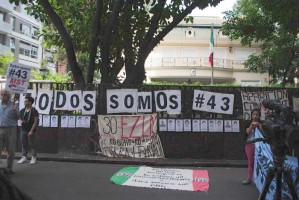
Wikimedia Commons
Mexico City, Sep 19 (EFE). – Amnesty International once again slammed the Mexican government over its response to the chilling case of 43 teacher trainees who disappeared nearly a year ago, saying its claims that the remains of a second student have been identified despite assertions to the contrary by forensic experts “reek of desperation.”
The London-based human rights group pointed out Friday that international forensic experts with the Argentine Forensic Anthropology Team said Thursday night that tests conducted by Austria’s Innsbruck Medical University allegedly identifying a piece of bone as belonging to student Jhosivani Guerrero de la Cruz were inconclusive.
Mexican authorities’ “baseless claims” about the latest positive ID appear to be a “cruel attempt to show they are taking action ahead of the one-year anniversary of the student’s enforced disappearance,” Erika Guevara Rosas, Americas director at Amnesty International, was quoted as saying in the statement.
“It looks like they are willing to stop at nothing to wash their hands of any responsibility over one of Mexico’s most shocking human rights tragedies in recent history,” she added.
“Instead of playing games with the lives and hopes of the relatives of the disappeared students, the Mexican authorities must make a serious and concerted effort to re-direct investigations and ensure no stone is left unturned until the whereabouts of all 43 students are established,” she added.
The Innsbruck Medical University said Thursday that it had used advanced DNA technology to successfully match two severely burned samples provided by the Mexican government last November with “relevant family references” of two of the missing students, referring to Guerrero de la Cruz and another student, Alexander Mora Venancio.
Mora Venancio had already been identified using conventional DNA technology last December by the same Austrian lab.
The spokesman for the parents of the missing students, however, said Thursday that the alleged identification of Guerrero de la Cruz was far less conclusive than that of Mora Venancia and that “for us, these are not the remains of Jhosivani.”
They and their supporters also reject Mexican authorities’ official account of the events of Sept. 26, 2014, in the southern city of Iguala, Guerrero state.
That night, police attacked students from the Ayotzinapa Rural Normal School, a nearby teacher-training facility, as they traveled through the city on buses as part of a protest against education reforms. Six people – including three students – were killed and 43 other students abducted.
Federal authorities say the incident was the work of corrupt municipal cops acting on the orders of a corrupt mayor with connections the Guerreros Unidos drug cartel who wanted to prevent the students from interfering with an official event.
The cops handed over the students to cartel gunmen, who killed the young people and burned their bodies to ashes at a garbage dump in the nearby town of Cocula, according to the official story.
Earlier this month, Inter-American Commission on Human Rights experts rejected that account.
Citing work by Jose Torero, a well-known expert on fire who had conducted field work, examined the evidence and reviewed the statements of the suspects in the case, it said in a report that “no evidence exists to support the theory based on the statements that the 43 bodies were incinerated” at the dump on Sept. 27, 2014, the day after the students disappeared, the experts said.
The evidence gathered in the case shows that “the minimum amount of fire needed to cremate the bodies could not have occurred” at the dump in Cocula, not even enough to burn one body, the report said.
AI has long criticized Mexican authorities over their response to the disappearances, saying in March that “despite worldwide attention on the issue, they have, for months, failed to properly investigate all lines of the case, especially the worrying allegations of complicity by armed forces.” EFE



