


 SIGN UP FOR OUR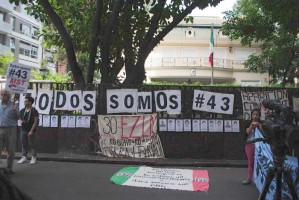
Wikimedia Commons
Mexico City, Dec 7 (EFE).– The Inter-American Commission on Human Rights, or IACHR, experts who examined the disappearance of 43 Ayotzinapa Rural Normal School students in southern Mexico said Monday that a study done by a weather and satellite imagery center bolsters the theory that the missing students’ bodies were not burned at the dump in Cocula.
“The satellite images captured all the daytime and nighttime fires, and there was no fire in the Cocula area” on Sept. 26 and Sept. 27, 2014, Angela Buitrago, a member of the IACHR’s Interdisciplinary Group of Independent Experts, said in a press conference in Mexico City.
The images, according to the IACHR experts, show that there was only one fire in the southern state of Guerrero on the night the students disappeared and it was not in Cocula, and a study by a meteorology center confirmed that it rained in the city of Iguala on the day in question.
“These facts allow us to move the search process to other places,” Buitrago said.
Iguala municipal police officers fired gunshots at students from the Ayotzinapa Rural Normal School, a nearby teacher-training facility, on the night of Sept. 26, 2014, Mexican officials say.
Six people died that night, 25 were wounded and 43 students were detained by police and then handed over to members of the Guerreros Unidos drug cartel.
Three suspects in the case – Patricio Reyes, Jhonatan Osorio and Agustin Garcia – confessed to having killed the students and burned their bodies at the dump.
The IACHR’s Interdisciplinary Group of Independent Experts said it asked the Attorney General’s Office to obtain a report from a weather center on the conditions in the area around the cities of Iguala and Cocula on Sept. 26 and Sept. 27, 2014.
“The study, dated Sept. 30, 2015 … indicates in its conclusions that the weather station in Iguala recorded accumulated precipitation of 21.8 mm between Sept. 26 and 1:00 a.m. to 4:00 a.m. on Sept. 27,” Alejandro Valencia, another of the experts, said.
The records for Cocula were not available, but “the report indicates that the forcasts and cloud images show a similar profile,” Valencia said.
The IACHR experts said in a report released on Sept. 6 that the bodies of the 43 education students were not burned at the dump in Cocula.
Peruvian fire expert Jose Torero, who was hired by the IACHR experts, concluded there was no evidence to indicate that the bodies of any of the students had been burned at the dump. EFE



