


 SIGN UP FOR OUR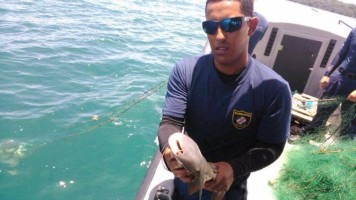
Source: Ministry of Public Safety
Oceangoing poachers and illegal fishing crews take note: The vigilant officers of the National Coast Guard Service of Costa Rica are actively looking for your nefarious traps and wicked gear, and they know about those hiding spots on the beach. According to a recent Facebook update posted by the Ministry of Public Safety, two recent Coast Guard patrols resulted in the confiscation of several dragnets and other illegal traps, and the officers also managed to rescue a few marine species.
A major aspect of the Coast Guard’s mission in Costa Rica is to preserve the coastal ecosystems and defend the rich biodiversity of our country. Such was the objective of a foot patrol deployed in Esterillos earlier this week. Commander Juan Carlos Vargas, chief of Coast Guard Station Quepos, explained that his officers were investigating reports of sea turtle carcasses on the sands of Playa Bejuco when they ran into a crudely cached trammel believed to be used by shrimping crews. As previously reported by The Costa Rica Star, the Constitutional Chamber ruled that the use of trawling nets and trammels to catch certain crustaceans is an unconstitutional act. The nets were promptly confiscated; the officers intend to launch future foot patrols in this area now that sea turtles are arriving for nesting season.
Rescue at Sea
Coast Guard officers aboard the GC 38-16 small boat were patrolling the ocean off the Playa Hermosa – Punta Mala National Wildlife Refuge when they spotted a dragnet and a trammel modified to catch lobsters. As the crew pulled up the illegal fishing gear, they noticed that quite a few species had already been caught.
It would have been quite the catch for the despicable fishing crew responsible for casting the unlawful nets. Coast Guard officers counted 15 lobsters, several species of fish, and an adult nurse shark (Ginglymostoma cirratum), which is a very docile bottom dweller. The crew of the GC 38-16 promptly liberated the shark, lobsters and fish. The two major infractions in this case would be the use of illegal fishing artifacts and catching species that swim in an oceanic refuge.



