


 SIGN UP FOR OUR
  The launch of the iPhone 4S in Costa Rica marks yet another step in this country’s growing demand for smartphones. Apple always does a great job with launch publicity, but this time someone in Apple forgot to make sure that SUTEL has agreed with the launch of the iPhone 4S. A launch lunch turned into a meeting about non-compliance with SUTEL rules. Details like the iPhone’s failure to have a plan for registering the IMEI numbers of the phones with SUTEL, and who was going to provide support. Until there was an agreement on these details, SUTEL would not certify the phone for use in Costa Rica. Without certification ICE (Kolbi), Claro, and Movistar would have been subject to fines for selling the phone. Details that could have killed the launch.
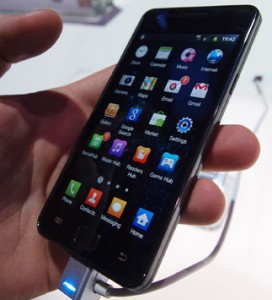
Grand marketing launches do not necessarily equate to a great phone. Since its release in February of 2011, the Samsung Galaxy SII ruled as the best smartphone on the market. Apple had to respond, and the response was the iPhone 4S. The push to regain dominance as the top phone in the market led to major labor disputes in China, with threats of mass suicide by plant workers to alleged violation of child labor laws. For all this, did Apple really create a phone that would challenge the Samsung Galaxy SII? Shouldn’t they use the billions in their overseas accounts to insure that these labor violations do not occur?
The Samsung Galaxy SII is lighter (116 grams) and thinner (8.5 mm) than the iPhone 4S, which weighs in at 140 grams and is 9.3 mm thick. This is a bit surprising as the Samsung Galaxy SII sports a 4.3 inch Super AMOLED Plus capacitive touchscreen compared to the iPhone 4S’s 3.5 inch IPS LCD touchscreen. Drop tests show that the screen on the iPhone 4S is more likely to break than the screen on the Samsung Galaxy SII. I would not recommend verifying these test results. It is cheaper to purchase a good protective case for the phone. When the iPhone screen breaks, it must go back to Apple for repair, while there are repair kits available for the Galaxy.
When it comes to screen resolution the iPhone 4S wins with a resolution of 940 by 640 pixels, which translates to 326 pixels per inch. By comparison the Galaxy SII has a resolution of 800 by 400 pixels for a resolution of 218 pixels per inch. Unfortunately, Apple forgot to upgrade the icons to match the higher resolution, so they appear grainy. The real question is at what point does the human eye become unable to detect the difference. When it comes to number of colors and contrast, the Super AMOLED Plus screen on the Galaxy SII beats the iPhone 4S.
The Galaxy SII uses a dual-core 1.2 gigahertz ARM Cortex-A9 chip, while the iPhone 4S uses an 1.0 gigahertz ARM Cortex-A9 chip. What makes the big difference is the Samsung Galaxy SII has 1 gigabyte of RAM versus only 512 megabytes on the iPhone 4S. Along with the extra horsepower, the Galaxy SII has a longer battery life, with 18 hours and 20 minutes of talk time (compared to 14 hrs on the iPhone 4S) and 8 hours 40 minutes of data time (compared to 8 hrs on the iPhone 4S). The iPhone 4S has went through a series of upgrades to even come close to these specifications.
When it comes to data storage, the Samsung Galaxy SII comes with 16GB of internal storage, and up to 32GB of storage on a microSD card. The Samsung Galaxy SII comes with an 8GB microSD card. The Apple iPhone 4S has no card slot, but comes in three models with 16GB, 32GB, or 64GB of internal storage.
Both phones have a 8mp rear facing camera with 3264×2448 pixels, autofocus, LED flash, and 1080p videos at 30fps. However, the CMOS illumination sensor, hybrid infared filed, and white balancing make the iPhone 4S a better camera. As for for front-facing cameras, the Galaxy SII 2 megapixel camera beats the iPhome 4S VGA camera. Plus, the iPhone 4S only supports video calls over WiFi.
The iPhone 4S supports the Bluetooth 4.0 standard, while the Galaxy SII supports the 3.0 standard. On the WiFi side, however, the Galaxy SII beats the iPhone 4S. Both can connect to WiFi networks, and both phones can act as a WiFi hotspot. The difference is that the Galaxy SII also supports DLNA (Digital Living Network Alliance) and WiFi Direct. DLNA is significant, as this makes the phone compatible with all devices that are part of DLNA. This includes WiFi capable TVs, Blu-Ray players, and host of other devices. The theory being that all DLNA devices should be able to interact with each other.
Apple continues its war with Adobe Flash, as the iPhone 4S Safari browser does not support it. On the other hand, the Galaxy SII does support Adobe Flash. The Galaxy SII also has an FM radio, which the iPhone 4S does not have. As for music players, the iPhone 4S is tied to iTunes, while the Galaxy SII supports a wide variety of audio and video media.
When it comes to operating systems, the Samsung Galaxy SII comes with Android 2.3 Gingerbread, although there is an update to Ice Cream Sandwich (the latest version of Android). The Apple iPhone 4S uses iOS 5. At the moment, the number of apps available from the Android Market is greater than number of available iPhone apps. The hot app for the iPhone 4S is Siri. Siri uses a natural language user interface to answer your queries, make recommendations, and perform actions by delegating requests to a set of web services. For instance, you can ask for the weather report, ask for direction, set reminders and so on. This application uses both your location and a Google search to find a response. Siri is highly dependent on Apple’s servers. How this is going to work in Costa Rica is yet to be seen. It definitely increases the network data load, and speed is going to be an issue.
Even though the two phones trade wins in features, the Apple iPhone 4S looks cool, and has the marketing force of Apple selling it. On the other hand, the Samsung Galaxy SII has a lot of features that are not present on the iPhone 4S. These are not cheap phones. The Samsung Galaxy SII sells for around 403,600 colones ($807 US). While the Apple iPhone 4S sells for 388,800 colones ($778 US) for the 16GB model, 448,700 ($897 US) for the 32GB model, and 508,000 colones ($1,016 US) for the 64GM model.



