


 SIGN UP FOR OUR
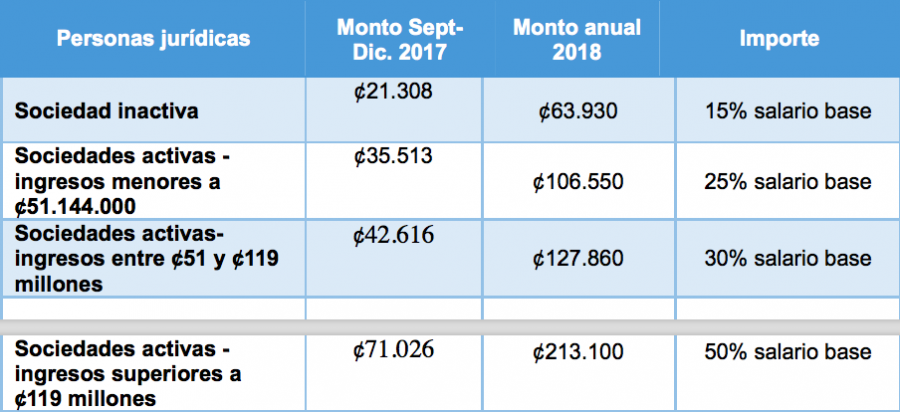
Starting September 1, 2017, the annual tax on corporations, including inactive – or “shelf” or holding – companies will begin to be collected, said president of the Association of Public Accountants, Ronald Artavia in a statement.
The law exempts micro and small businesses from payment; and a one-time exemption is included for the first year of the tax on people who close their companies or transfer them.
The tax applies to all corporations, limited liability companies, limited partnership, partnerships, individual limited liability company, among others. Failure to make payments on the dates established will result in fines and interest that will accrue daily, as well as other consequences, emphasized Artavia.
For 2017, companies will be required to pay only for September – December.
The 2018 annual fee will be due on full in January 2018. See the table under images for 2017 and 2018 amounts for the different types of companies:
“Companies that are in arrears under the previous law are not exempt from the payment of the tax, but, if within the first three months of the law taking effect, they cancel their prior debt, they will not have to pay fines or interest,” Artavia said.
Companies who do not comply with the tax will not be able to participate in contracts or bids with any governmental institutions. In addition, non-payers will not be able to get certificates of legal status from the National Registry, nor will they be able to carry out other types of legal transactions.
Inactive companies are required to file Form D-140 – Declaration of Modification of Data – indicating the tax address, email and other data on the form. Failure to submit this statement within the established period will result in a fine of half a basic salary (¢213,100) for each month the form is not on file, or a fraction thereof corresponding to any partial-month delay.
“The law exempts micro and small enterprises registered as such by the Ministry of Economy, Industry and Commerce, and also small and medium-sized agricultural producers registered with the Ministry of Agriculture and Livestock, and registered in the General Directorate of Taxation,” explained Artavia.
Revenue generated by the tax will largely benefit the Ministry of Public Security, with 90 percent of the collection being allocated for the construction of police stations, the purchase and maintenance of police equipment, and in police patrols. The remaining 5 percent of the tax revenue will go to the Ministry of Justice, and the other 5 percent to the Judicial Investigative Police Agency.



