


 SIGN UP FOR OUR
 By Wendy Anders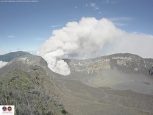
Starting at about 2:00 a.m., Costa Rica’s highly active Turrialba Volcano sent up a column that was mainly gas and vapor, with a minimal amount of ash, reported the National University’s Volcanology and Seismology Research Institute (Ovsicori-UNA).
The colossus has been lying low for over a month after, after over the past year having had several strong eruptions that have coated nearby areas with ash, and have even affected flights at Alajuela’s Juan Santamaría International Airport some 60 km west of the volcano.
This latest eruption resulted from a volcanic tremor. Volcanic tremors occur when gasses, water or magma flow along crevices and ducts in the interior of the volcano causing vibrations of varying magnitudes, explained the institute’s scientists on their site. The tremors can last for minutes or for days at a time, explained Ovsicori-UNA.



