


 SIGN UP FOR OUR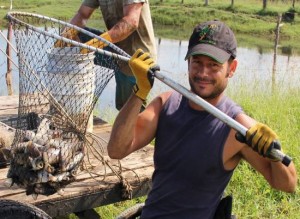
At Finca Neptuno in 2011. Source: Facebook
Author’s Note: This is the eighth item in a series of articles that touch on the subject of sustainable practices in Costa Rica. There is a high degree of innovation and street smarts involved in sustainability; if you happen to know of a good sustainability tip, please feel free to share it with The Costa Rica Star.
Massive industrialized farming is a double-edged sword. On one hand it has fed global populations for centuries, put money in the pockets of many farmers, and significantly contributed to the growth of national economies -particularly in Brazil. On the other hand, it displaces small family farming operations and depletes the soil from its precious biomass and nutrients until it becomes nearly barren.
Aquaponics is an ancient method of farming that combines aquaculture (fish farming) with hydroponics (growing plants with mostly water and little to no soil). Aquaponics is emerging as a sustainable method of food production as it combines farming of edible fish and vegetables, it is very eco-friendly, and can be deployed in parts of the world where mass farming has rendered the soil sterile -such as in parts of Africa.
A previous article in The Costa Rica Star explained how Cuban farmers are turning to agro-ecology as a way to reverse the damage caused by industrial farming and the lack of fertilizer and pesticides in that Caribbean nation. This is similar to permaculture, which is a philosophy of farming and raising livestock in a manner that is sustainable and preserves natural ecosystems.
Finca Neptuno
Scientific exploration of aquaponics and permaculture takes place at Finca Neptuno in Canas, a town close to the Corobici River in Guanacaste. Two hundred acres of land have been reserved for this project by the Mendocino Ecological Learning Center, Nor Cal Aquaponics and AquaBiotic systems.
Prior to its transformation into an aquaponics research center, Finca Neptuno was a fish farm. Once the Nor Cal Aquaponics took over, they cleaned up the land and the ponds and resumed breeding of crayfish, eels, shrimp, and of course tilapia, catfish and other edible species. Then came the floating farms and recirculating aquaponics systems that convert fish waste into fertilizer.
Simple aquaponics techniques can yield a decent amount of herbs and vegetables, but what about feeding entire communities and producing enough crop yield to enter agricultural markets? Finca Neptuno is working on that, too. The farm is now being used to produce rice in a large scale, growing on shallow crayfish ponds. After each crop of rice, the crayfish clean and prepare the fields, while feeding and fattening up in the process.



