


 SIGN UP FOR OUR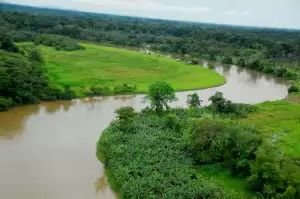
Part of the San Juan River
Strong warnings by scientists, a sobering maritime navigation analysis and the sudden death of a Chinese engineer are among the latest news coming from the controversial and quixotic Nicaragua Canal project, which appears to moving away from the San Juan River and Costa Rica’s northern border. However, some analysts believe that the move may be temporary.
The Nicaragua Canal is certainly big news for Costa Rica, Guanacaste and the rest of the world. In recent weeks, National Geographic, New Scientist, La Prensa, Estrategia y Negocios, and even The New Yorker have dedicated considerable journalistic resources to the unwieldy project. Depending on the news source one chooses to believe in, groundbreaking could either take place in December or never.
In Costa Rica, the National Chamber of Radio Broadcasters aired commentary from Captain Elgin Francisco Bermúdez, who has navigated both oceanic and fluvial canals for more than 50 years. Captain Bermudez was very clear about two things: He believes that the cost of the Nicaragua Canal could be reduced to $8 billion and actually be constructed with all the environmental damage it would entail. The problem, however, would be to use any portion of the San Juan River for navigation as it would require permission from Costa Rica to install buoys and special maritime navigation aids on land. In absence of such navigation aids, Captain Bermudez explains, no ship captain would dare sail the canal and no insurer would issue policies on vessels or cargo.
The comments from Captain Bermudez may explain the new sketches published by National Geographic and Estrategia y Negocios, which both show paths that do not touch the San Juan River. Still, at its shortest route, the proposed Nicaragua Canal would still be 100 miles longer than the Panama Canal. Writing for National Geographic, Roff Smith observes:
[…] many economists, scientists, and sociologists say that the time for a Nicaraguan canal has long since lapsed, that the waterway—if it’s ever completed—will end up being the world’s costliest boondoggle.
And they warn that a canal through Nicaragua could be an environmental disaster, destroying more than a million acres of rain forest, jeopardizing Lake Nicaragua—Central America’s largest source of fresh water—and disrupting the lives of indigenous people, while delivering few, if any, of the promised benefits to ordinary Nicaraguans.
Although project supporters claim that most environmental disaster warnings are coming from haters in Costa Rica, New Scientist actually printed an interview with Jorge Huete-Perez, president of the Nicaraguan Academy of Sciences, who supports the warnings.
In March, Jon Lee Anderson wrote about the project for The New Yorker:
[…] the magnitude of the plan called for a grand gesture. Ortega’s canal would be the largest civil-engineering and construction project in the world. To lead it, and to bring in money and expertise, he had recruited an obscure Chinese tycoon named Wang Jing, and two days before the ceremony, the National Assembly had approved a concession that put a large swath of the country at Wang’s disposal as a building site. Yet for months, as rumors about the canal spread through Nicaragua, Wang had not appeared in public.
The 40-year old Wang Jing has been described as enigmatic and not altogether credible to be able to accomplish the project. The Financial Times has highlighted the unlikely entrepreneur as someone whose prior projects in Nicaragua have not accomplished much at all. One of Wang Jing’s key employees, Wang Ching, lost his life at a river in Punta Gorda in Nicaragua a few weeks ago. La Prensa of Panama reported his death as an accidental drowning that occurred when the Chinese engineer, who was considered crucial in the project, fell in the river after eating lunch.



