


 SIGN UP FOR OUR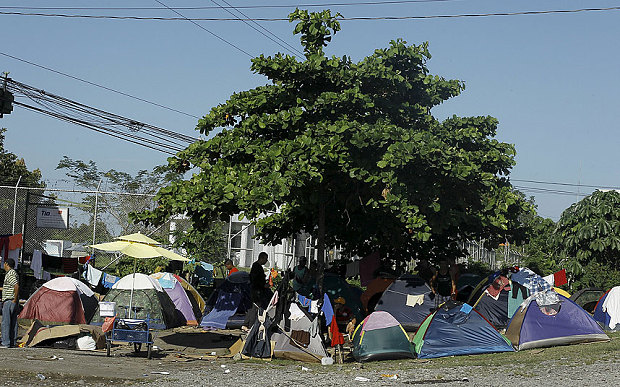
The tents of Cuban migrant refugees are seen at a border post with Panama in Paso Canoas, Costa Rica, earlier in December Photo: Reuters OMX
Just days since Panama and Costa Rica declared that the airlift of thousands of Cuban migrants that had been stranded in both countries en route to the United States had been completed, ostensibly putting an end to the Cuban migrant crisis that saw some 8,000 Cuban migrants airlifted out of Costa Rica to the Mexico-United States border, another 1,000 new Cuban migrants have now piled up on the Panama-Costa Rica border, according to the Spanish EFE news agency.
“In Chiriqui, the Panamanian province that borders Costa Rica, there are about 1,000 Cubans,” waiting to continue their journey northward, Osiris Abrego, the program coordinator for Caritas International, an agency of the Catholic Church that oversees social issues, told EFE on Thursday.
The Cuban migrant crisis exploded last Nov. 15 when Nicaragua, a political ally of Cuba, decided to close its border, claiming risks to its security and sovereignty, which caused almost 8,000 Cubans to accumulate in Costa Rica.
The Costa Rican government stopped issuing visas to the islanders in mid-December and said it was no longer able to admit any more people. As a result, some 1,000 Cubans were left stranded in Panama, forcing the Panamanian government to strike its own accord with Mexico to fly the migrants northward.
What at the time was believed to be the last of those Cubans – a group of 300 migrants – were flown from Panama to Mexico on a commercial flight on Saturday, when the Panamanian government declared the airlift operation, which consisted of nine flights over three weeks, to be completed.
Now, however, it seems that the flow of Cubans has not ended, despite the fact that Panamanian Vice President and Foreign Minister Isabel De Saint Malo de Alvarado asked migrants last Monday to avoid trying to travel through Central America.
Meanwhile, conditions for the latest group of 1,000 migrants on the Costa Rica border are worse than those faced by the Cubans who came before them, as the Panamanian government has ceased providing them with humanitarian aid, according to Caritas International.
The migrants also cannot be airlifted to Mexico, because the accord between Panama and Mexico applied only to the Cubans left stranded in Panama when Costa Rica stopped issuing them visas in mid-December, and does not apply to any new arrivals.
According to Caritas, not only is the Panamanian government not providing humanitarian aid, the government is attempting to dismantle their encampments.
For his part, the director of Panama’s National Migration Service, Javier Carrillo, denied those claims and said that the migrants were being cared for.
“Of course we are helping them. Anyway, Costa Rica is who is causing the problem [by not issuing them visas], we cannot do anything, what can we do? We can not force another country to receive foreigners,” Carrillo told EFE.
Cuban nationals receive preferential immigration status upon setting foot in the United States under the Cuban Adjustment Act, commonly known as the “wet foot, dry foot” policy.
However, warming relations between the United States and Cuba have led to fears on the island that the policy may come to an end, sparking an unprecedented wave of Cuban migration that hasn’t been seen in decades.



