


 SIGN UP FOR OUR
 By Wendy Anders
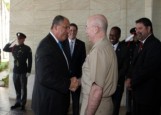
Costa Rica’s President Luis Guillermo Solís and U.S. Navy Adm. Kurt Tidd, commander of U.S. Southern Command, greet each other prior to the opening ceremony for the Central American Security Conference April 7 in San Jose. Photo by Jose Ruiz, SOUTHCOM
Today President Obama and Vice President Biden received Costa Rican President Luis Guillermo Solis at the White House.
Encouraged with the outcome of the meeting, Solís said, “The topics we discussed in the meeting with President Obama and Vice-President Biden have increased like never before the bilateral cooperation for fighting organized crime.”
The U.S. pledged assistance to aid Costa Rica in keeping transnational criminal organizations from penetrating the Costa Rican society; in reducing the tide of drugs transiting Costa Rica en route to the United States; and in developing prevention programs, according to the U.S. Embassy in Costa Rica.
The substantial aid package is aimed at “transforming Costa Rican capabilities … by addressing the underlying causes of violence to ensure safer Costa Rican borders and communities,” continued the embassy in a press statement.
The leaders also discussed broader issues such as migration, at-risk youth, job opportunities, strengthening local communities, women’s empowerment, and alternative energy. The U.S. pledged support in several of these areas.
“In order to support the Costa Rican police forces to efficiently patrol the country, its waters and airspace, we will work together to increase the capabilities of the Coast Guard of Costa Rica, the Air Surveillance Service, and Border Police in order to strengthen these organizations,” stated the Embassy, which went on to list the specifics of the assistance:
Two 110-foot patrol boats to be based in the Pacific is the U.S.’s biggest investment in this bilateral security aid package. Valued between US$25 and $30 million, the donation is aimed at long-term safety and includes extensive training for Costa Rica’s Coast Guard crew, and a two-year maintenance package for the craft. The boats will arrive in Costa Rica in the second half of 2017, stated the embassy.
An additional large donation of two C-145 cargo planes (valued at $20 – $25 million) will be made, as well as additional boats: one 45-foot boat; two 38-foot interceptors, and a 19.5-foot riverboat.
The leaders cited the effectiveness of the countries’ regular and ongoing exchange of information which has led to recent large maritime drug seizures.
To strengthen this work, the U.S. pledged funding for a guard station and dock in Golfito in Costa Rica’s southern pacific region. In addition, equipment will be provided to strengthen the Air Surveillance police to conduct round-the-clock counternarcotics maritime operations together with the Coast Guard; and the unit’s King Air aircraft will be remodelled for a cost of $1 million.
A hangar and operations center for air surveillance will be built in Coto 47, Ciudad Neily as well as a new checkpoint at Kilometer 35, both near the southern border with Panama.
To also aid in migration work, Costa Rica will receive field equipment for biometric identification of undocumented migrants, as well as equipment and training of the border police’s mobile brigades.
Migration and border police will receive tents, folding beds and blankets for more than 2,400 people to be used as needed for disaster relief.
The U.S. pledged its support to work together with law enforcement, judicial, and the correctional sector work to strengthen the capacity of the police to tackle organized crime, conduct effective investigations, and prosecute criminals, as well as create a modern correctional system.
To these ends, the embassy supports efforts to create an Organized Crime Unit for the Judicial Investigation Organization (OIJ). Advice and equipment are needed to achieve this goal.
In addition, three armored vehicles will be donated for use by security forces, the police’s Special Intervention Unit, and the OIJ.
Virtual target-shooting ranges will be designed for the police and Coast Guard to practice and hone their skills. And a US$350 thousand donation will be made to the Canine Unit of the Penitentiary Police for its exemplary work in the region.
In other areas, the U.S. pledged US$40,000 in communication equipment to improve the safety of guards and visitors to the Corcovado National Park on Costa Rica’s southern Osa Peninsula.
And for women’s safety, the U.S. pledged support for victims of sexual assault consisting of training and equipping 450 officials to form Sexual Assault Response Teams, and the donation of a thousand hygiene kits for victims of sexual assault.
Equipment and training for Costa Rica’s Juvenile Restorative Justice program was offered to help reintegrate young people who have had trouble with the law back into society.
Advisors and equipment were pledged for the country’s forensic laboratory so it can apply for international accreditation.
Funding was pledged for the Rahab Foundation to combat human trafficking, tend to victims of human trafficking in the northern part of the country, and educate public officials and the general public about the problem.
To improve outcomes for at-risk youth, prevent youth drug use and involvement in crime and gangs; and to create a positive relationships between communities and the police, the U.S. pledged a continuation of its training, equipment support, programs, grants, and technical assistance.
The Central America Regional Security Initiative’s two-year US$2.2 million scholarship program which currently benefits 2,431 at-risk youth by providing job skills, leadership, entrepreneurship will receive an additional US$1.57 million more next year.
This year the United States Department of Labor awarded a US$3 million grant over the next four years for Costa Rica to provide on-site job training programs for at-risk youth.
The Youth Action Program has been pledged US$460,000 to prevent school dropouts and drug abuse among youth in Puntarenas and Limón Provinces.
The Gang Resistance Education and Training program in Costa Rica has been granted US$200,000 for police officer training and equipment. The program which is offered throughout Costa Rica will be expanded from the 3,000 children reached in 2015 to a goal of educating 8,000 youth in 2016.
To strengthen Costa Rica’s educational system, a new English curriculum will be developed with the Ministry of Public Education to provide youth with skills for better job opportunities.
Through the U.S. English Access Microscholarship program, US$571,000 has been disbursed to provide English teaching to at least 500 college students over the last three years.
And finally, a donation to the MarViva Foundation for US$350,000 will be provided to organize small communities in the Gulf of Nicoya to aid in increasing security in the region by drawing on local residents’ knowledge of criminal tendencies and strengthening their connections with government and police authorities, stated the U.S. Embassy.



