


 SIGN UP FOR OUR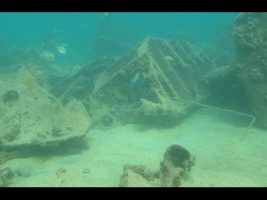
(YouTube / ODN)
Spain’s Minister of Justice, Rafael Catala on Monday proposed leaving some US $4 billion to $17 billion worth of gold and silver on the seafloor off the coast of Colombia in order to avoid conflict over its ownership.
The treasure is the cargo of the legendary galleon San Jose, a Spanish ship that was sunk in 1708 near the coast of Cartagena of the Indies, which was discovered more than 300 years later in late November of last year.
Experts describe the San Jose as the “holy grail of shipwrecks,” with a trove of gold, silver and jewels valued somewhere between USD $4 billion and $17 billion.
However, within days of discovering what is possibly the largest lost treasure ever found, Colombia, Spain, and US investors who financed the search for the wreck all laid claim to the treasure in December 2015.
Despite the disagreement, the foreign ministers of both Spain and Colombia, in a joint statement in December, agreed to work together to seek ways to protect “a wreck that is part of the heritage of humanity,” though the Colombian foreign minister emphasized at the time that the galleon’s cargo “will not be divided” between Spain and Colombia.
Speaking to the Colombian newspaper El Tiempo on Monday, Spanish Justice Minister, Rafael Catala said that the best idea would be to leave the wreck on the seafloor and use parts of its treasure for a museum.
“We can say that the vessel is Spanish, as according to international law a ship has the nationality of the flag it sails under when it sinks. Inside there are hundreds of Spaniards who died at the time of siking, and because of that we think the best to do with a sunken ship is to respect the cultural heritage it represents and leave it where it is,” Catala said, saying that the proposal to leave the ship and its multi-billion dollar cargo on the seafloor represents the official Spanish proposal to avoid a legal confrontation before international courts.

The 300-year-old wreck contains an estimated US $4 billion to $17 billion worth of gold and silver coins as well as other jewels.
Built in 1698 and loaded with gold and silver coins, the San Jose set sail in early 1708 from Portobelo, Panama, together with other ships of the Spanish Armada, en route to Cartagena of the Indies, but near the island of Baru it was attacked by English pirates and was sunk by cannon fire.
“[The San Jose] is a discovery of international importance, it constitutes one of the greatest discoveries and identifications of our submarine heritage, if not the very greatest, some say, in the history of humanity,” Colombian president, Juan Manuel Santos said in December, adding that the shipwreck is “the heritage of all Colombians and protecting it ought to be a national mission.”
EFE contributed to this report. [h/t] Colombia Reports



