


 SIGN UP FOR OUR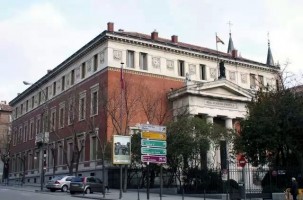
Royal Spanish Academy in Madrid. Wikimedia Commons
San Juan, Mar 9 (EFE).- The director of the Spanish Royal Academy predicted a grand future for Spanish in the United States, thanks to the growing regard for the Hispanic population living there.
“Spanish in the U.S. is gaining tremendous momentum thanks to the growing regard for Hispanics,” Dario Villanueva said in an interview with Efe in San Juan, where he was to take part Monday in the presentation of the 23rd edition of the academy’s Dictionary of the Spanish Language.
As an example of the importance of Spanish in the U.S. he mentioned the fact that any Spanish-speaking tourist in New York City can get around its streets with no more help than the language of Cervantes.
In his opinion, being bilingual is something positive in modern society, and Spanish itself is a good example of a language that lives in harmony with many others.
In the case of Puerto Rico, Villanueva said that it has “enormous symbolic significance” the fact that Spanish is the language most commonly spoken on the Caribbean island, despite having been a territory of the United States since 1898.
He recalled that Puerto Rico, together with Cuba and the Philippines, were the last territories of the Spanish Empire, but in the U.S. commonwealth, unlike in the Asian country, the vitality of Spanish is undeniable even though English is its official language.
For the director of the Royal Academy, the fall of the Spanish Empire is precisely what consolidated Spanish as a global language.
“It is independence that gave strength to Spanish and not the colony,” Villanueva said, recalling that in the Spanish imperial era only 20 percent of the inhabitants of Spain’s territories in the Americas spoke Spanish.
The presentation Monday of the 23rd edition of the dictionary will be a lead-up to Villanueva’s participation Tuesday in signing the agreement to hold the 7th International Congress of the Spanish Language at San Juan in March 2016.
Health problems of Cervantes Institute director Victor Garcia de la Concha prevented the head of the organization from making the trip to Puerto Rico, where he will be represented by his academic director, Julio Martinez Mesanza.
The International Congress of the Spanish Language is a triennial meeting that serves as a forum for delving into the progress and problems of Spanish today. EFE



