


 SIGN UP FOR OUR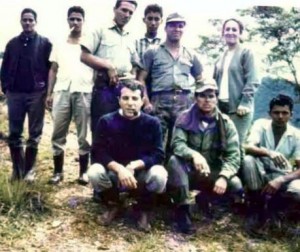
Clyde de Zurro and search party in Talamanca, mid-1960s. Source: tc-48.com.ar
In November 3rd of 1965, a military aircraft from the Argentinian Air Force carrying 68 airmen experienced damage in one of its engines and plunged into the jungle of the indigenous Talamanca region of Costa Rica. More than 45 years later, the mystery of what really happened to the crew and passengers of that unfortunate flight remains.
According to newspaper La Manana de Cordoba, the families of the airmen who perished on that flight, most of them young airmen who had just finished training, will be traveling to Buenos Aires to ask their Minister of Defense to put together a search party to locate the remains of their loved ones.
“We just want to know the truth so we can get closure”, explained Regina Zurro, who is the surviving daughter of one of the airmen who disappeared along with 67 others. The aircraft was an old Douglas C-54 Skymaster under the command of Flight Commander Renato Felippa. It departed from the city of Cordoba and its final destination would have been the city of San Francisco in California. After taking off from the old American Howard Air Force Base in Panama, the TC-48 made radio contact with a Tico pilot bound for Miami. LACSA pilot Alvaro Protti maintained communication with the TC-48 as the crew reported a fire on engine number four.
Strange Discrepancies
There have been a series of discrepancies found over the years by the surviving relatives of the airmen. For one, the TC-48 was an old aircraft, built in 1939. It could only accommodate five crew members and 44 passengers, which means that it was overloaded, and may have previously flown at higher altitudes tan recommended. The maintenance records of the TC-48 were sketchy, and allegations of evidence planting and suppression by the Argentinian Air Force clouded the investigation in the mid-1960s.
The murky events surrounding the disappearance of the TC-48 occurred during the backdrop of the Cold War, a time when cloak-and-dagger affairs and cover-ups were commonplace.
“The search for remains was paid for by surviving relatives for 42 years, and it was just in 2008 under Nestor Kirchner’s administration that a group of military officers with a different mentality got involved”, remembers Regina Zurro, who was just eight years old when she last saw her father boarding the tragic flight. Regina’s mother, Clyde de Zurro, traveled to Costa Rica where she spent a year and a half in Talamanca searching for her husband’s remains and living with the Bribri indigenous people. The widow passed away last year without ever finding out exactly what happened.
A High-Tech Search
In recent years, our government has gotten involved in finding out more about the vanishing of the TC-48 and the airmen. With the help of NASA and the Massachusetts Institute of Technology, a new search was conducted utilizing innovative satellite and laser sensor technology, which proved no match for the dense canopy of our forests in Talamanca.
One of the mysteries that the surviving relatives will attempt to clear up on their trip to Buenos Aires is why the Argentinian Air Force went as far as to concoct a story, and even plant evidence, in which the TC-48 would have crashed in the Caribbean.



