


 SIGN UP FOR OUR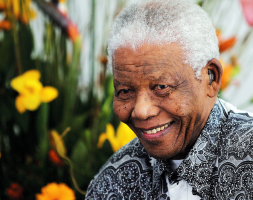
By order of President Laura Chinchilla, the flag of Costa Rica mournfully flew at half-mast on Friday, Saturday and Sunday in memory of the late Nelson Mandela, the former President of South Africa who bravely fought the forces of apartheid and dreamed of a truly free and peaceful nation. Did you know that the great Nobel Peace Laureate Mandela dedicated one of his first literary works to a Tico, and that he insisted on shaking the hands of Costa Rica’s National Football Team during a friendly match against South Africa? Why?
Let’s start with Mandela’s young life and his early struggles against the odious apartheid regime of South Africa, which actually supported Adolf Hitler and the Third Reich during World War II. Mandela was arrested for his rebellious activity against apartheid, which is defined by the Princeton lexical database as:
A social policy or racial segregation involving political and economic and legal discrimination against people who were not whites; the former official policy in South Africa.
Mandela was arrested and tried for treason and a multitude of trumped-up charges in the late 1950s. He had been on the run from his antagonists; but, according to media reports, his whereabouts were conveniently given to the South African regime by the United States Central Intelligence Agency (CIA). Back then, the U.S. agency was keeping tabs on Mandela due to his ties to leftist ideology and his revolutionary streak, which were considered threats to the American way of life in the early days of the Cold War. It is interesting to note that U.S. global spying has only intensified since then.
The future president of South Africa had been imprisoned a few years when Fernando Volio Jimenez arrived in the United Nations (UN) by virtue of his appointment as ambassador by the late President Francisco Orlich. When Volio was born in 1925, Cartago was still the capital city of Costa Rica. Volio arrived at the UN with high ideals and motivation. He had lived through the painful Costa Rican Civil War and was proud of his beloved country’s decision to abolish her armed forces at a time when dictatorships and immoral regimes were appearing all over the world.
Volio was instrumental in convincing the UN to form an investigative group to monitor human rights across the globe. In 1963, the UN General Assembly approved the Declaration on the Elimination of All Forms of Racial Discrimination. One of the first objectives under this declaration was to monitor the ongoing apartheid situation in South Africa, and a committee of African leaders was convened. The leaders of this committee had been impressed by Volio’s commitment to human rights and Costa Rica’s peaceful ways and thus appointed him vice-president of this committee.
Two years later, African leaders elected Volio to preside this special committee, and at the general assembly he addressed the world and firmly stated that it was the obligation of the UN to end apartheid, and that South Africa had no future under that restrictive and execrable policy. In that same year, an imprisoned Mandela was admiring Volio’s work and writing a book simply entitled “Apartheid,” which is one of his early sociopolitical writings. Mandela thought about dedicating the book to Volio, but that is not easy to do when you are in a dark cell in Robben Island.
Volio would continue the work of his beloved human rights committee. He once angered the United States and the repressive Chilean regime of Augusto Pinochet when he chose to visit political prisoners there. In 1996, former President Jose Figueres invited Volio to come along on a trip to South Africa. Said trip sought to establish trade relations between Costa Rica and the African nation, which has been an example of industrial development since Mandela became President. Volio could not believe that he would finally meet the political prisoner he had fervently worked to release during his stint at the UN.
The delegation from Costa Rica had coordinated with the South African presidential security corps to make the meeting somewhat of a surprise, and Volio had brought two copies of his own 1971 book: “Apartheid: Prototype of Racial Discrimination.” According to an article by Jose Melendez for Revista Soho in 2010, Mandela was excited to shake Volio’s hand and elated to receive his book as a present. He then grabbed the other copy and wrote:
To Fernando Volio: Best wishes to a dynamic and experienced diplomat.
In 2003, the national football teams of Costa Rica and South Africa would play a friendly match in Potchefstroom, which is a community located southwest of Johannesburg and on the banks of the Mooirivier. Mandela had apparently learned about the sad news of Volio’s passing less than a month after meeting him in 2006, and he insisted on appearing on the pitch and shaking the hands of the visiting players, who were not expecting such honor.
The passing of Volio and Mandela are somber reminders that the world should not take human rights for granted, and that they are worth fighting for.



