


 SIGN UP FOR OUR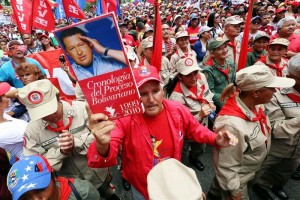
Supporters of President Maduro rally in Caracas EFE/AGENCIA VENEZOLANA DE NOTICIAS/
Washington, Mar 19 (EFE).– The Obama administration’s designation of the situation in Venezuela as a threat to U.S. national security may herald a military intervention, the Venezuelan foreign minister said Thursday at the Organization of American States headquarters in this capital.
“History has shown that declarations like this tend to precede military inventions,” Delcy Rodriguez said in an extraordinary session of the OAS Permanent Council, going on to warn that recent sanctions imposed on several top Venezuelan officials by the U.S. administration could be the prelude to an “economic blockade … as our brother people (in) Cuba have suffered for over 50 years.”
She said that the Venezuelan government was warning that this prospective U.S. invasion is a “real threat … against Venezuela, against its legitimate government and against its people … whereby hegemonic interests are attempting to take control of the world’s largest petroleum reserves.”
Rodriguez said that, last week when U.S. President Barack Obama declared a “national emergency” over Venezuela’s situation, “the power whereby the U.S. State Department and the Treasury impose sanctions on whoever is very broad.”
“The Venezuelan people are not going to allow their political, or economic or cultural sovereignty to be violated,” the foreign minister warned, adding that the sanctions imposed on seven high Venezuelan officials – for human rights abuses, Obama said – do not affect only those officials.
She said that her government believes in the “peaceful resolution of disagreements” and that a year ago it had extended “a hand to the U.S. (to begin) a dialogue under conditions of respect and … equality.”
Meanwhile, U.S. deputy representative to the OAS Michael Fitzpatrick said that the designation of Venezuela as a national security threat had been “taken out of context.”
“The U.S. did not create the problems Venezuela faces,” he stated, adding that “my government does not wish to see a Venezuela that is unstable or in poverty … we want to see Venezuela thrive and return to a state of prosperity.”
He also said that “many countries in the region” share Washington’s concern over human rights in Venezuela, but he did not name any specific nations.
Fitzpatrick went on to say that the declaration of a “national emergency” regarding Venezuela gives the U.S. president the legal basis to impose sanctions on individuals or entities and issuing it was a legal requirement for imposing on Venezuela the sanctions approved by Congress last December.
He said that the United States has used that declaration “dozens of times” against other nations, adding that the only U.S. aim was to prevent certain Venezuelans whom Washington believes have committed human rights abuses from traveling to the United States or placing their assets in the U.S. financial system.
Fitzpatrick went on to criticize the arrests of opposition leaders on political charges, the growing restrictions on civil society, the lack of an independent judiciary and the disregard for freedom of expression and association in Venezuela.
According to diplomatic sources consulted by Efe, at present it is not expected that the OAS session will result in any declaration regarding the tension between Washington and Caracas such as the one issued by the Caracas-led ALBA group and the Union of South American nations, known as Unasur. EFE



