


 SIGN UP FOR OUR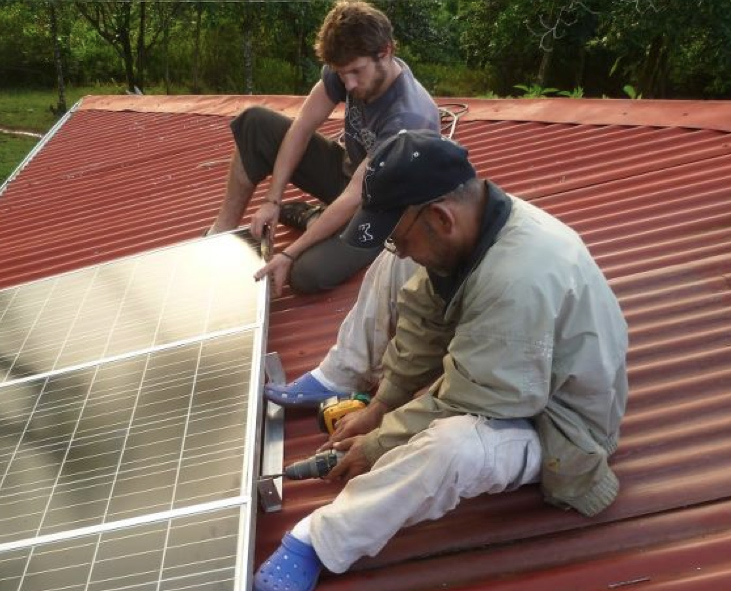
Renewable World recently visited our programme sites in Nicaragua, the first stop of which was Kahka Creek Nature Reserve in the Rio Wawashang area of the Southern Atlantic Autonomous Region (RAAS), accessible by a 3-hour boat journey from the Caribbean hub of Bluefields, followed by a 40-minute walk from the riverside community of Pueblo Nuevo. Managed by local NGO – Foundation for Autonomy and Development on the Atlantic Coast of Nicaragua (FADCANIC), this wonderful 640ha rainforest reserve, home to a wealth of biodiversity, protects a valuable swathe of rainforest from deforestation and attracts tourists and research groups from across the globe.
Until Renewable World’s intervention, the reserve’s power needs for the eco-lodge, training centre, wood workshop and the forest wardens’ living quarters relied on scattered solar systems which had been gradually installed with total generating capacity of only 800w. A diesel generator had to be used for 8 hours daily, using 5-6 gallons of diesel. This was costly (with the price of diesel increasing by 20% in the last year), unsustainable and polluting.
In 2011, Renewable World partnered with Nicaraguan NGO blueEnergy to install a centralized mini-grid solar system, more than doubling the generating capacity to 2kW.
Miguel Ruiz Galeano, Technical Coordinator for the reserve, spoke about how life has changed at the reserve since the installation of the mini-grid solar system, supported by Renewable World:
“Before, if we had large groups of visitors, there wasn’t enough energy capacity, the energy would cut out and there would be no light. We couldn’t use the projector for training courses to deliver presentations without transporting the generator to the training centre or the eco-lodge. Before the integrated system was installed, the generator often broke, which was really frustrating, especially when you had prepared for training sessions which we then couldn’t deliver without sufficient energy.
Thanks to the newly installed centralized mini-grid system, we can now deliver training sessions with a projector, and we can also power four computers, a printer and the fans. There is now sufficient power for the training centre, workshop and eco-lodge, as well as the living quarters of the forest warden.”
The reserve is a multi-use hub for the nearby communities. The training centre is used for running courses ranging from conservation and the use of natural resources to training fire-fighters to control forest fires and supporting youth at-risk through skills development. In addition, the eco-lodge is used as an outreach medical centre by visiting medial brigades for local communities.
Whilst at Kahka Creek, we also the opportunity to meet Arling and Jesus, who had both participated on the youth-at-risk programme delivered at Kahka Creek’s training centre which included technical training on the renewable energy system by blueEnergy. Arling and Jesus were then able to actively participate in the installation of the centralized mini-grid system, cabling and installing plug sockets.
Jesus explained: “I had to ask my Mum permission to take part in the training programme which was really interesting. I’ve since been able to put my learning into practice in my own home, ensuring the plugs are wired correctly.”
One of the carpenters at the reserve, Juan Albarez, also sang praises of the newly installed system:
“We used to have to work solely with the generator, using up to 6 gallons of diesel per day. With the renewable energy system, we never use more than 2 gallons per day. It’s made my job easier and I now save time – before, I’d have to spend up to 30 minutes getting the generator going, even if I just wanted to cut a small piece of wood. There used to be a lot of noise from the generator which could be heard up to 2km away, and my ears were ringing by the end of the day! Now there is only noise from the tools themselves and no longer the strong smell of burning fuel from the constant use of the generator”.
Miguel added: “The project has been great, and really positive; it’s benefited everyone who has visited us. Visitors have been able to see first-hand and learn from a really good renewable energy system. Some local producers in the communities are installing solar systems themselves, having seen how beneficial they can be [to meet energy requirements], whilst not harming the environment. Communities know that the energy doesn’t cut out in Kahka Creek and everyone talks about it!”
Click here to read more about Renewable World’s Central America Programme



