


 SIGN UP FOR OUR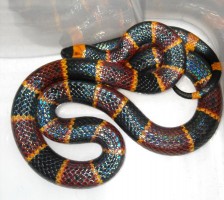
Wikimedia Commons
Of all the venomous snakes in Costa Rica, the fearsome gargantilla (Micrurus mipartitus) is often regarded as one of the deadliest. The powerful venom of these snakes can not only cause instant tissue necrosis but also excruciating pain, epilepsy, shock, and death. What is it that makes this reptilian venom so potent?
According to a recent study in Proceedings of the National Academy of Sciences, a respected scientific journal published in the United States, researchers from several universities investigating the biochemical makeup of micrurus venom have found that its potency involves a strong binding of toxins to gamma aminobutyric acid (GABA), an amino acid found in the central nervous system that acts as and inhibitory neurotransmitter.
Per a news story filed by the Agence France Press (AFP) and published on Yahoo UK & Ireland earlier today, researchers found that gargantilla venom contains:
a pair of proteins called micrurotoxins (MmTX) that bind to pores on GABA nerve cells, which are located in the spinal cord and the brain.
Once these MmTX bind to the GABA receptors, they hold on and do not let go, which explains the delirious behavior of snake bite victims, which is often followed by deadly seizures.
To a certain extent, MmTX proteins function in a similar fashion as the active ingredients in anti-anxiety medications such as alprazolam and diazepam (Valium). These drugs attach to GABA receptors much like MmTX do, but they do not hold on so tightly. Whereas a loose binding to GABA receptors causes relaxation, the tight binding of MmTX causes nerve cells to misfire, thus resulting in seizures.
The research study was conducted by herpetologists and scientists from the University of Costa Rica, Aix Marseille University in France, Johns Hopkins University in Baltimore, Maryland, the Universitat des Saarlandes in Germany, and University Medical Center Hamburg-Eppendorf in Germany.
This study on snakes in Costa Rica is significant insofar as paving the way for further research not only into the treatment of snake bites in Costa Rica and other regions where highly venomous ophidians can be found; this research can also help advance research into effective treatments of epilepsy, chronic pain and schizophrenia,



