


 SIGN UP FOR OUR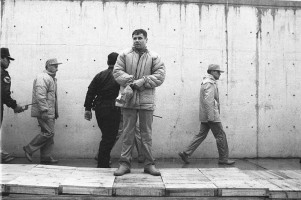
“El chapo Guzmán” por Fabrizio León Diez – Obra do próprio. Licenciado sob CC BY-SA 4.0, via Wikimedia Commons
Mexico City, Jul 12 (EFE).– Drug lord Joaquin “El Chapo” (Shorty) Guzman escaped from the Altiplano I federal prison in central Mexico through a 1.5-kilometer (nearly one-mile) tunnel that led to a house, officials said Sunday.
Guzman, who had been held at the prison in Mexico state, which surrounds the Federal District and forms part of the Mexico City metropolitan area, since his arrest on Feb. 22, 2014, escaped on Saturday night, the National Security Commission said.
The Sinaloa cartel boss was last spotted by guards monitoring security cameras at 8:52 p.m., when he approached the showers in his cell block.
Guards noticed that some time passed and Guzman did not emerge from the showers, so they went to investigate and found “a hole measuring 50 by 50 centimeters and 1.5 meters deep,” National Security Commissioner Monte Alejandro Rubido told reporters.
Guzman’s escape is an “affront to the Mexican state,” President Enrique Peña Nieto said in Paris, where he begins an official state visit on Monday.
Peña Nieto said he instructed authorities to make every effort to recapture the drug lord as soon as possible.
The tunnel was equipped with a ladder, a ventilation system made with PVC pipes, lights and a motorcycle mounted on rails that was apparently used to haul out the dirt, Rubido said.
Guards found construction equipment, oxygen tanks and fuel tanks in the tunnel, the national security commissioner said.
The Altiplano I federal prison is in Almoloya de Juarez, a city located about 25 kilometers (15 miles) from Toluca, the state capital, and some 90 kilometers (55 miles) from Mexico City.
The tunnel led to a house that is under construction just southwest of the prison in the Santa Juanita district of Almoloya de Juarez.
Different items were found at the property that pointed to the “presence of workers or lookouts,” Rubido said.
The U.S. government on Sunday offered Mexico assistance in recapturing Guzman.
“The U.S. government stands ready to work with our Mexican partners to provide any assistance that may help support his swift recapture,” Attorney General Loretta Lynch said in a statement.
Guzman was serving the last three years of a sentence for a prior conviction at Altiplano I and prosecutors planned to try him on additional charges linked to his criminal activities.
“We share the government of Mexico’s concern regarding the escape of Joaquin Guzman Loera ‘Chapo’ from a Mexican prison. In addition to his crimes in Mexico, he faces multiple drug trafficking and organized crime charges in the United States,” Lynch said.
Guzman, who was born in 1957, got his start in the drug business as a lieutenant of Miguel Angel Felix-Gallardo, the top leader of the Guadalajara cartel, in the 1980s.
He was a pioneer in transporting cocaine and marijuana from Colombia to the United States in large aircraft, which later returned loaded with millions of dollars in small bills.
Felix-Gallardo’s arrest and prosecution in 1989 led to the Guadalajara cartel being divided up and Guzman relocating to Culiacan, the capital of Sinaloa state, and founding the Sinaloa cartel.
Guzman was eventually captured in 1993 in Guatemala and sent back to Mexico, where he was convicted on bribery charges.
On Jan. 19, 2001, with just seven months remaining on his sentence, Guzman escaped from the Puente Grande penitentiary in the western state of Jalisco, pulling off the Hollywood-style jailbreak by hiding in a cart full of dirty laundry in front of guards.
It marked the first time in Mexico that an inmate had escaped from a maximum-security facility and the incident shed light on how thoroughly the drug cartels’ tentacles extended to all corners of Mexico’s criminal justice system.
Guzman’s cartel rose to become one of the main sources of illicit drugs entering the United States.
The Mexican drug kingpin’s wealth led to his name regularly appearing on Forbes magazine’s list of global billionaires. EFE



