


 SIGN UP FOR OUR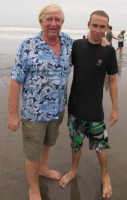
Father and son at the beach in Jaco.
“There is no grief like the grief that does not speak.” – Henry Wadsworth Longfellow
Nearly two months ago, deep heartbreak struck Britt Nelson at his home in Jaco Beach:
The hardest part about Coady’s death, for me, was finding him dead in his bed the morning of June 8. He was just lying on his side with his head on his pillow. The TV was still on. He simply laid down and died, with me sleeping only 12 feet away in my bedroom. I freaked out…
I wept over his body while holding him in his bed. I can’t even hardly write this down right now. I can’t get the sight of my son — dead in my arms — out of my mind. I can’t stop seeing his face. But that night, it is clear to me and comforting to know that our good Lord came and got Coady that night and took him to the Kingdom and free from the horror of heroin.
Author’s Note: I rarely take on a personal narrative when writing a news report; I am making an exception this time. There is a companion piece to this article, which you can read at our sister publication ICRNews, formerly known as Inside Costa Rica. That article is about the heroin trade in Costa Rica and the connection to Florida, and includes an interview with a drug dealer.
When I first spoke to Britt Nelson, a retired journalist and newspaper editor from the United States who moved to Costa Rica a few years ago, I heard the voice of a man painfully struggling to understand life. His son Coady was never supposed to die from a heroin overdose in Jaco Beach; he came here as part of an effort to get better.
Mr. Nelson was kind enough to call me because I did not have enough credit on my prepaid cell phone; he immediately told me that he had faced such situations as a newspaper journalist. It only took a few minutes of conversation for me to realize that I was on the phone with a good man. Mr. Nelson is a Baby Boomer; his first job was selling and delivering the Washington Post newspaper at the age of 8. He would later study Mass Communication and was employed as a journalist for the New York Times Regional Newspaper Group. Before coming to Costa Rica, he retired in Florida as editor of the Palatka Daily News in 2002.
As it happens, Coady’s obituary would be printed on the Palatka Daily News:
Coady Brittain Nelson, 26, formally of East Palatka, died unexpectedly Monday, June 8, 2015 at his home in Jaco Beach, Costa Rica.
Coady attended school in Putnam County. He loved gardening, animals and experiencing the many wonders of Costa Rica. Coady moved to Costa Rica to live with his father in May 2014. He was a member of Horizon Church of Jaco Beach and had recently been baptized.
He was preceded in death by his mother Jeni Nelson, formerly employed by LaFarge and Century 21 A1A Real Estate in Palatka.
Coady is survived by his father, Britt Nelson of Jaco Beach, one sister, Jasmine Hunley Greenroyd of Las Vegas, two brothers, Graham Michael Hunley of Johnson City, Tenn., and Jesse Chad Nelson, of Ketchikan, Alaska; and special friends, Vickie Brozino of Interlachen and Margaret Zahner of San Mateo. He is also survived by his grandparents, Flo and Dick Strange of Cave City, Ky.; aunt, Debbie Strange of Cave City, Ky.; three uncles, Ted Strange and Rob Strange, both of Elizabethtown, Ky., and Nick Strange of Athens, Ga.; and three cousins Julia Rasdall of Bowling Green, Ky., Richard Strange of Park City, Ky., and Stephen Adams of Cave City, Ky.
When Mr. Nelson and I started our email correspondence for this report, I offered him the Longfellow quote that starts off this article. I have personally known and helped two people who have lost loved ones to drug overdoses; despite this experience, I always second-guess myself as to how to deal with these situations. I wrote to Mr. Nelson:
I guess that is part of the mystery of death. God called upon your son to leave turmoil behind and to reach a state of peace that all of us hope to reach one day. Coady’s relief comes through your grief, and we can only guess that is the way God intends it to be.
Mr. Nelson said he wanted to make a difference with this story about his son’s death. Among the many emotions he has been dealing with, there’s anger at how easy it became for Coady to score the bag of heroin that killed him. He wrote:
“Heroin and cocaine dealers are murderers. They should be hunted down and removed from society one way or another.”
In the course of doing research for this story, I interviewed Jose Carlos, a taxi driver/drug dealer who plies his trade in San Jose. I told this man about Coady’s death and about how his father felt. Upon hearing this, Jose Carlos turned pensive and said that he would likely feel the same way if that ever happened to his own daughter. Moreover, Mr. Nelson wrote:
“I hope my son’s death serves as a wakeup call for Jaco’s Policia (Fuerza Publica). This deadly drug — Heroin — is available on Jaco’s streets. Jaco isn’t that big [of] a town. Policia need to dig in and find informants, use undercover officers and rid the streets of open air drug sales.”
Mr. Nelson thinks that Coady got heroin from one of the dealers who retail openly on street corners just blocks away from the beach at different spots around Jaco, where the street drug market is quite lucrative in comparison to other parts of Costa Rica. Although Jaco Beach, which is sometimes called “Gringo Beach,” has been trying to shake off its image as a place where prostitution and drug use are rampant, the town is still a haven for debauchery among expats and visitors who seek the party atmosphere.
What makes Coady’s death so devastating is that he came to Costa Rica to get better, and he was on the right path. He had been sober thanks to a faith-based recovery program. I mentioned to Mr. Nelson that I reviewed some of Coady’s social media updates shared with friends, and that his posts seemed sincere. While reading his Facebook Timeline, I could see that Coady liked firearms and rap music; I asked Mr. Nelson about this, and he confirmed both, but he also added that his son enjoyed rock as much as hip-hop. Furthermore, Mr. Nelson wrote about life with Coady:
“I was there when my son Coady was born in Kentucky and I was there when he died 26 years later in Costa Rica. In between, Coady was a wonderful, beautiful son in every way. He grew up in Florida’s country life where the warm wind blew free and so did the cows and chickens. He loved the outdoors and wildlife and fishing and boating and Scouting.
He could drill a water-filled milk jug at 120 yards with a 30-30 Winchester when he was 8 years old. I saw him do it two times in a row while sitting on the tailgate of my pickup truck. Coady’s only comment to me was, ‘I guess I will never have to do that again ‘cause I did it……twice.’
Coady was a shy boy, easily labeled an introvert, but once you got him going he could carry on a conversation with anyone on just about any subject. Friends and family would always comment about Coady’s ability to communicate with anybody. He often would bring home stray animals, some injured. We had every kind of pet you can imagine and this went on well into Coady’s adulthood. Coady once put a 3-foot alligator in his bathtub for a pet.
He did not go to high school, but instead chose home schooling. As soon as he turned 16, he did computer study for 2 weeks and passed his GED test. Coady’s world began to collapse when he was 12, when the word cancer came into our lives. Coady and his mom were very close and they shared a special bond…far beyond a normal mother/son relationship. Every night my wife would give Coady a soothing back rub and so would he. Every night. Jeni Nelson died Sept. 5, 2006 of colon cancer. Our world spun out of control.”
I asked Mr. Nelson about whether his wife’s untimely passing may have triggered his son’s conflicted life and drug use. He responded:
Coady never got over his mother’s death. He talked of her daily is if she had only gone out of town.
Coady’s life in Florida included trouble with the law. As explained by Mr. Nelson, it all started with an arrest for “drug trafficking,” which is how Florida, and many other jurisdictions in the United States, choose to handle drug possession and marijuana cultivation, and this is part of the War on Drugs. According to Mr. Nelson, Coady was growing three or four marijuana plants, mostly for his own use and to share with friends.
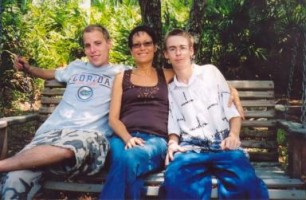
The late Jeni Nelson with her sons.
As it happens to many other drug-related defendants in the U.S., Coady’s life worsened after his arrest, conviction and imprisonment. Mr. Nelson explained that his son could not adjust to probation after prison; he failed the mandatory urine drug analysis screening more than once, which resulted in being sent back to jail for violations of his conditional release. This revolving-door criminal justice system is quite common among drug offenders in the Sunshine State and across the U.S.; it keeps the prison industrial complex alive and fuels a bustling economy.
Coady got a lucky break from a judge who utilized the common sense and wisdom that is sorely lacking from the U.S. War on Drugs. When it became clear that Coady’s life was quickly becoming an in-and-out of jail grind, a judge accepted his proposal to get back his U.S. passport and move to Costa Rica to be with his father. He settled with Mr. Nelson in Jaco Beach; it did not take him long to fall in love with the country; Coady learned surf fishing with borrowed equipment and liked the abundant wildlife.
Many expats from the Sunshine State like Costa Rica because of proximity and affinity. Florida, like Costa Rica, is beautiful; both places offer ample opportunities for fishing, which Coady loved. Mr. Nelson owned boats in Florida, and thus he often took Coady out fishing. Such was not the case in Costa Rica; fishing boat charter trips around Jaco Beach are quite expensive. Drugs, on the other hand, are cheaper and easier to get in Costa Rica than in Florida.
Coady would not have gotten in legal trouble in Costa Rica for drug possession. As previously reported by The Costa Rica Star:
Under the laws of the country, drug use is not a crime but rather a public health matter that requires prevention and treatment if it leads to addiction. Under this doctrine, for example, a police officer cannot arrest someone smoking marijuana in public, although the officer can destroy that personal amount on the spot. The same goes for other drugs: amounts that indicate personal use do not lead to arrests; larger amounts, however, may be signal an intent of distribution, smuggling, delivery, or dealing.
Setting aside the criminal justice comparisons, Coady did not join his father in Jaco Beach to do drugs. The legal wrangling that took place in Florida was for him to get sober, but anyone who has been addicted to heroin and other opiates can tell you that it is not that easy. Mr. Nelson did not give money to his son because he knew it would be easy for him to find drugs in Jaco Beach.
I know it must have been very difficult for Mr. Nelson to tell me how Coady used to get violent when he was refused money. Officers from Fuerza Publica, the national police force of Costa Rica, responded to a domestic violence call at the home of Mr. Nelson. Like many other expats from the U.S., Coady got a lucky break, but his lack of funds would ultimately result in a robbery arrest.
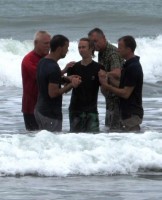
The baptism of Coady Nelson
Rage, depression and despair are often manifest in those who try to rid themselves of heroin. Coady’s desperation to get money so that he could get high prompted him to break into a home in Jaco Beach; amazingly, he caught yet another lucky break as the Fiscalia (prosecutor’s office) of the Garabito canton gave Coady an option of faith-based drug recovery or a term of prison in the overcrowded correctional system of Costa Rica. He chose wisely and was baptized.
Despite his legal troubles, I detected a hint of a good guy when going through Coady’s social media history. This was confirmed to me by Mr. Nelson:
In 2013, I went back to Florida after Coady got thrown out of his living arrangement with his brother Graham in South Jacksonville, Fl., because of a move-in girlfriend. No son of mine was going to be homeless, if I could help it.
I rented a 1-bedroom apartment shared with Coady. [He] became friends with many people in the complex. One Saturday morning, two women […] got in a fight in the rear parking lot and they were rolling around the pavement until they both got to the rear fence. They both went under the unattached chain-link fence and dropped 15-feet to the creek bed below.
Coady saw all of this happening…when the women went through the fence Coady took off running to the end of the parking lot where he could get down to the creek. Coady found [one of the women] in the creek barely able to keep her mouth out of the water… kinda like water-boarding.
Coady held her head out of the water until rescuers arrived and he talked to her. I was a witness to Coady’s actions on that day. The woman Coady saved from drowning suffered a broken back in several places. The other [woman] got up and ran away never to be seen again.
To this day, Mr. Nelson does not know exactly how his son was able to get his last heroin fix:
After Coady got out of church-based rehab a few months ago he was clean and he stayed clean. He told me several times that he would never do heroin again, but for some unknown reason on the night of June 7/8 he shot up heroin. I don’t know where he got the money or the heroin. I have read that users who stay off for a while are at increased risk because when they shoot up again they do the same amount as before and it kills them.
Struggling to understand how his son died, Mr. Nelson did some online research and found the following:
I am an expert on addiction and well, if you have to die, a heroin overdose is the way to go. It is a *painkiller* par excellence, it doesn’t cause pain. You get euphoric and then fall asleep and just slowly stop breathing without any awareness that anything has gone wrong. If you do develop any awareness that there’s a problem, you are typically so high that it doesn’t bother you. That’s why it can be so dangerous– it can make you not care.
Of course, this explanation is of little comfort to Mr. Nelson. No amount of explanations will change the fact that Coady is gone, and Mr. Nelson’s grief is exacerbated by what he feels is an outrage: the easy availability of heroin in the streets of Jaco Beach, where he chose to live his golden years. He has learned about heroin “epidemics” in the U.S., and he asked me if a similar situation was happening in Costa Rica; reports from the Narcotics and Addiction Institute (Spanish acronym: IAFA) do not indicate so, but there has been an increase that seems to be parallel to the growing population of expats in our country. I wrote a separate article about heroin use in Costa Rica, which you can find on ICRNews.
When it comes to grieving over the loss of a loved one, we typically experience anger before coming to terms with loss, which is what Mr. Nelson feels towards heroin. Not long ago, The Costa Rica Star published a note about “James Douglas Morrison,” a musical theater play written by Mr. Nelson about the life of the legendary singer of The Doors, who presumably passed away from cardiac complications related to heroin use, the same narcotic that took away his son’s life.

Mr. Nelson bids goodbye to his son Coady
Mr. Nelson spread some of Coady’s ashes at sea in Jaco Beach; the rest of his son’s cremated remains were shipped to the U.S. Mr. Nelson intends to stay in Costa Rica to enjoy our country and the friendly support of his Christian faith group. Seeing Coady’s baptism in the surf off Costa Rica’s Pacific Coast, and his subsequent period of living sober, will forever be one of Mr. Nelson’s most cherished experiences, for it was in those same waters where his remains were spread.
Through my rapport with Mr. Nelson, I got the feeling that he is definitely the type of expat that we like to attract to our country; he often remarked on how professional, supportive and respectful the police officers, prosecutors and forensic agents were when they responded to the report of Coady’s death, and he is forever thankful for the chance his son was given in our country. The fact that he wants to alert others about the availability of heroin in Costa Rica is commendable. To me, writing this has been an honor.



