


 SIGN UP FOR OUR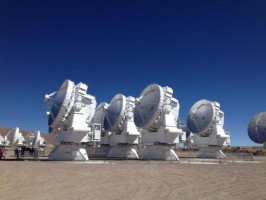
ALMA instrument array in Atacama, Chile
Santiago, Nov 11 (EFE).- The ALMA observatory, located in the middle of northern Chile’s Atacama desert, announced that it will join with other telescopes around the planet to create a telescope as large as the Earth which will be able to spot objects just 10 cm (4 in.) wide on the Moon.
In a statement, the Atacama Large Millimeter/submillimeter Array, or ALMA, considered to be one of the largest astronomical observatories in the world, says that the technique consists of combining the data gathered by “two or more telescopes” to create a virtual telescope with a collection dish equal in size to the geographical distance between them.
This effort is part of an international project that will allow the creation of a “virtual telescope the size of the Earth,” with very high resolution, using the technology known as very long baseline interferometry, or VLBI.
ALMA said that three tests have been run on the use of VLBI with other international telescopes as key steps toward including ALMA in the Event Horizon Telescope project, a worldwide network of telescopes that will study the supermassive black hole scientists believe is located in the center of our Milky Way galaxy.
For the observatory to be able to participate in the VLBI project, it first had to upgrade the abilities of its telescopes to get its 66 antennas to function in unison as a single radio dish 85 meters (279 ft.) in diameter.
The first test was undertaken in January 2015, when one of the ALMA telescopes was linked to the Atacama Pathfinder Experiment telescope located at a distance of two kilometers (1.25 miles).
The same kind of test was performed again in March and achieved greater separation distances, successfully creating a link with the 30-meter Institut de Radioastronomie Millimetrique’s (IRAM) telescope in Sierra Nevada, in southern Spain.
The data obtained in this later test were combined into a single image with a resolution of 34 micro-arcseconds, allowing the combined telescopic network to detect an object less than 10 cm (4 in.) in size on the Moon.
The latest observation was performed in August, when ALMA linked up with six antennas of the U.S. National Radio Astronomy Observatory, creating a virtual telescope the size of the Earth which observed the 3C 454.3 quasar, one of the brightest radio-objects in the sky, despite the fact that it is located at a distance of 7.8 billion light years, or more than half the distance to the observable “edge” of the universe. EFE



