


 SIGN UP FOR OUR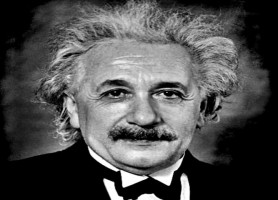
Wikimedia Commons
According to Einstein’s Theory of General Relativity, which we all learned in school as a way of understanding how gravity works, bodies moving through space are affected by deformation, or warping. Amazingly, last Thursday a team of scientists announced that they had recorded the sound of two black holes colliding a billion light years away, thereby providing scientific proof of gravitational waves – just as Einstein predicted some 100 years ago.
Interestingly, two Latinas were intimately involved in this scientific discovery: Dr. Gabriela Gonzalez and Dr. France A. Cordova.
“We are over the moon and back,” said Dr. Gonzalez of Louisiana State University, a spokeswoman for the LIGO Scientific Collaboration (Laser Interferometer Gravitational-Wave Observatory), “Einstein would be very happy, I think.”
France A. Cordova is the director of the National Science Foundation, which spent about $1.1 billion doing the research that led to one of the biggest discoveries in science – gravitational waves.
Why is this important?
Firstly, we now know definitely that gravitational waves exist, and how to detect them.
Secondly, the signal picked up by the LIGO station is the strongest evidence to date of the existence of a binary black hole system, just as Einstein had predicted.
Thirdly, this discovery is the strongest direct evidence that black holes really do exist.
Gravitational Waves could offer us a window into the origin of the universe…
LIGO is the biggest project funded by the National Science Foundation, who have been working since 2002 to find and prove that gravitational waves do exist. It was after an upgrade to their tracking system in 2015, that their equipment was sensitive enough to detect a surge of gravitational waves. Einstein was right all along.
Dr. Gonzalez was born in Argentina, but received her Ph.D. from Syracuse University. She was the first woman ever to receive tenure in the physics department at Louisiana State University.
Dr. Cordova was born in France, but her father was Mexican-American. She received her Ph.D. from California Institute of Technology, and went on to become the first Latina Chancellor of University of California Riverside, and later the first female president of Purdue University.
These two Latinas seem to understand smashing through glass ceilings as well as detecting gravitational waves. Bravo.
“The thing that Dr. Gonzalez and I share is a passion for science. We’re both driven by our curiosity to understand the universe,” Cordova told Fox Latino News.
Both women agree that there’s a dearth of women in science. Gonzalez stated, “Science is so exciting. Without more women in science, we are missing out.” Cordova adds, “Bringing more diversity to science simply makes science better. We see more richness of ideas, more interesting questions raised.”
The Latin American world watches and waits to see what might be next for these two Latina brainiacs. We can hear Einstein grinning with approval.
About the Author
Carol Blair Vaughn holds a Master’s Degree in Performing Arts and is a retired college professor from Washington, D.C. She inherited her love for Latin America from her father, the former U.S. Ambassador
to Colombia, Panama, and Director of the Peace Corps, Jack Vaughn. Carol writes for the Association of Residents of Costa Rica (ARCR) and for an English language club in the southern region of Costa Rica. In the past, Carol served as Editor in Chief of What’s on Tap magazine.



