


 SIGN UP FOR OUR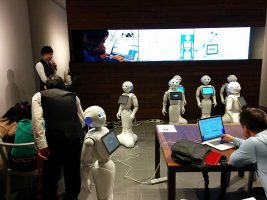
By Hanonimas – Own work, CC BY-SA 3.0, Wikimedia Commons
By Antonio Hermosin
Can an android awaken human empathy and remedy loneliness? The maker of popularrobot ‘Pepper’, Kaname Hayashi – who is now working on a robot to play that role and aspires to make it a household name – certainly thinks so.
Hayashi’s Pepper was the first robot capable of interpreting human emotions and language, and since going on sale in 2015, Pepper has become a common presence in commercial establishments as one of the most recognizable faces of Japan’s cutting edge technology.
“It was a giant step forward in robotics and showed that the home robot market has immense potential,” said the proud creator in an interview with EFE at his Akihabara office in Tokyo.
Hired by Japanese telecommunications giant SoftBank to lead the Pepper project in 2012, the 45-year-old mechanical engineer left the company shortly after the June 2015 market launch of the curvy-bodied, amiable-looking robot, who enjoyed astounding commercial success with the first 1,000 units selling out within a minute.
A few months down the line, Hayashi founded his own venture – Groove X – which seeks to develop a different type of home robot based on the principles of non-verbal communication, non-human appearance and an ability to emotionally connect with people.
Stressing that what interests him are machines that help people feel better, Hayashi has recruited 20 people from disciplines ranging from biology and industrial engineering to dance and videogaming for the project.
He rues that while artificial intelligence is increasingly finding its way into everyday gadgets like smartphones or cars, “not many tech firms are working to cater to basic human needs like affection or social acceptance.”
His new project was born after he visited an old age home with Pepper; he saw elderly inmates trying to talk with the robot, and noticed that despite challenges in communication due to software limitations, the robot was received quite well by them.
“Some of them just wanted to touch him, or take him by the hand. Others only needed to be heard,” says Hayashi, who thus discovered that achieving “subconscious communication” with the machine “was more important than perfect verbal interaction”.
The key to making such a machine is “connecting with the most primitive part of our brain, that has to do with instincts, emotions and intuition,” according to Hayashi, who cites examples of fictional robots from the Star Wars saga including the iconic R2 D2 and BB-8, who despite little physical likeness to humans and non-verbal communication have proven to be wildly popular.
The new robot, which he plans to launch near 2019, will be shorter than Pepper’s 120 centimeters, have a simple design with intelligence comparable to that of a cat.
He envisions the robot playing a role similar to that of a pet but with augmented functions, including motivating its master during exercise, accompanying him in routine chores or helping reduce stress through games and entertainment.
The engineer, who believes technology is now advanced enough to help us feel less lonely and more happy, underlines that “we want to create a robot everyone can have, in terms of functionality as well as price,” and foresees significant demand potential in Japan, China and big cities across the globe, where a sizeable number of people live alone. Tokyo, Jun 28 (EFE)
A Humanoid Relationship With Pepper
Tokyo, Jul 04 (EFE).- Reaching 120cm in height and 28 kilograms in weight, Pepper does not enter in the category of ‘portable’ robot. But those characteristics don’t stop Tomomi Ota to take Pepper in a cart to stroll in her neighborhood, go shopping or even take the subway together.
In June 2014, when Pepper was presented for the first time by Japanese telecommunications and Internet corporation Softbank at a press event, Tomomi looked at the presentation via a live broadcast on Ustream.
While some people were ‘scared’ or reluctant about the new humanoid robot, curiosity pushed her to apply for a lottery sale for the first lot of 200 Peppers. She was lucky enough to acquire then a ‘Developer’s Pepper’, the first models of the robot, which needed to be programmed by its users.
Pepper entered Tomomi’s home in November 2014 and was soon also adopted by her parents to become a member of the family.
Having degrees in media design and music, Tomomi had to learn programming and her efforts deepened her bonds with her new friend.
Capable of reading human emotions and to adapt to his interlocutor, the robot, created by Aldebaran Robotics and SoftBank Robotics, is mainly used as customer service agent in stores and some 1,000 units are sold out in minutes after coming on the market every month.
Pepper is also making his way to Japanese homes but few can enjoy so much outdoor life like Tomomi’s one.
Asked if she isn’t worried about damaging her robot friend during her many activities, the 30-year-old said that she is taking extra care as she couldn’t imagine being separated for two months from Pepper, the average time needed for a repair. EFE



