


 SIGN UP FOR OUR
 By Wendy Anders
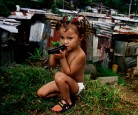
La Carpio, an impoverished neighborhood in the San Jose metro area. (CRS Archive)
After participating in the United Nations General Assembly last week, Costa Rica has been reviewing its progress on a number of fronts.
The UN has an ambitious goal of ending all forms of social exclusion and to promote inclusive development by the year 2030. The 2030 UN Agenda for sustainable development includes 17 goals, the first of which is the elimination of poverty in all its forms and dimensions, including extreme poverty.
To meet this goal, Costa Rica needs to get creative fast, as its poverty rate has hovered around 20 per cent for decades. And last year’s Household Survey (ENAHO) reconfirmed that figure by finding 21.8 per cent of Costa Rican households are in poverty according to the Multidimensional Poverty Index (WPI), reported the Costa Rican Planning Ministry last week.
A national dialogue was launched this weekend called “No One Left Behind” will seek to develop a multi-institutional national agenda to address the existing inequality faced by these estimated 318,421 poor households with their over 1.2 million inhabitants.
Eliminating poverty “is the biggest challenge facing the world and is an indispensable requirement for sustainable development. A major challenge in the case of Costa Rica is the need to improve coordination between institutions and programs, where Costa Rica in recent years has shown significant progress,” said the Planning Ministry.
Minister of Human Development and Social Inclusion, Emilio Arias Rodriguez said existing paradigms and structures must be changed ,and a series of transformations proposed which merge together the use of technology, interagency coordination, and a new model of care for families in extreme priority in which technical tools guide resources allocation in proportion to identified needs, and social programs are monitored and evaluated.
Alice Shackelford, United Nations Development Programme (UNDP) representative in Costa Rica said priority should be given to excluded groups such as women, indigenous people, Afro-descendants, LGTBI, people with disabilities, and migrants. In Costa Rica, households headed by women are overrepresented among those living in poverty, where 43.5 per cent of poor households are headed by women.
“The 2030 Agenda offers a great opportunity for Costa Rica to agree on long-term national agenda to achieve real and lasting change in the fight against poverty and inequality, as well as building a more inclusive and sustainable economic development model over time to ensure that nobody is left behind. It is essential to include the human dimension, and meet every family and every person living in poverty, to identify the characteristics and experiences they share, and thus understand how they perceive access opportunities and programs for this population,” Shackelford said.
The activity is organized by the office of the Vice President of the Republic, the President’s Social Council, the Ministry of Human Development and Social Inclusion / IMAS, the Ministry of National Planning and Economic Policy (MIDEPLAN), the United Nations Development Programme (UNDP) and the United Nations Fund for Children (UNICEF).



