


 SIGN UP FOR OUR
 NOBEL PHYSICS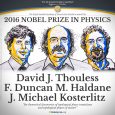
Copenhagen, Oct. 4 — Three British scientists won the 2016 Nobel Prize for Physics, announced the Royal Swedish Academy of Sciences on Tuesday.
David Thouless, Duncan Haldane and Michael Kosterlitz were awarded the Prize for their research into exotic states of matter, which has paved the way for the development of innovative materials.
“This year’s Laureates opened the door on an unknown world where matter can assume strange states,” said a statement by the RSAS.
It explained that in the 1970s, Kosterlitz and Thouless demonstrated that previous theories on superconductivity (a phenomenon where certain materials emit magnetic fields and have no electrical resistance when cooled down) were incorrect.
During the 1980s, Duncan Haldane discovered that the properties of chains of small magnets could be understood with topology, a branch of mathematics that studies spaces that are continuously deformed.
“Over the last decade, this area has boosted frontline research in condensed matter physics, not least because of the hope that topological materials could be used in new generations of electronics and superconductors, or in future quantum computers,” said the statement.
Half of the 8 million krona ($930,000) prize is to be given to Thouless, while Haldane and Kosterlitz are to split the other half. EFE



