


 SIGN UP FOR OUR
 By Wendy Anders
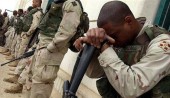
U.S. soldiers exiting Iraq; a large portion were affected by post-traumatic stress disorder. File photo.
A senior analyst at Brown University’s Watson Institute for International and Public Affairs in Providence, Rhode Island last week expressed outrage at the slew of bombings being carried out by the U.S. throughout the Middle East in the wake of recent attacks on Yemen.
“American forces are already fighting, carrying out drone attacks, and ‘advising’ ground troops in Iraq, Syria, Libya, Mali, and Somalia,” wrote Stephen Kinzer in an opinion piece for the Boston Globe.
The recent bombings in Yemen are oddly being described as “limited self-defense,” and are a continuation of the U.S. involvement in that country’s civil war. The U.S.’s exit strategy from this latest conflict is unclear, as are the objectives of the intervention, continued Kinzer.
“Since 2002, our drone attacks have reportedly killed more than 500 Yemenis, including at least 65 civilians. We are also supplying weapons and intelligence to Saudi Arabia, which has killed thousands of Yemenis in bombing raids over the last year and a half — including last week’s attack on a funeral in which more than 100 mourners were killed,” said Kinzer.
With no vital national interests at stake, it seems that the U.S. simply has an abiding addiction to forcing other nations to bend to their will, bringing America millions of new enemies with each press of the attack button, continued Kinzer’s opinion piece.
“The United States no longer enters wars as we did in earlier eras. Our president does not announce that we have taken up a new cause in a distant land. Congress does not declare war, which is its constitutional responsibility. Instead, a few buttons are pressed and, with only a brief and quickly forgotten spurt of news stories that obscure more than they reveal, we are at war,” wrote Kinzer, in a chilling summary of our current militaristic reality.
Whereas during the Cold War, the Persian Gulf states were viewed as an extension of U.S. vital interests due to their proximity to the then Soviet Union, and the U.S.’s dependence on Gulf oil supplies; today under a new global paradigm, this approach is no longer valid, holds Kinzer.
Rather, “today [the U.S.] naval presence in the Persian Gulf serves mainly to increase tensions, escalate conflicts, and make negotiated solutions more difficult. Almost inevitably, it draws [the U.S.] into local conflicts. [The U.S.] secures waterways through which oil is transported to India, China, and Japan — none of which contribute a cent to defray the cost,” said Kinzer.
The main beneficiaries of the U.S.’s numerous conflicts and bombings are the Saudis and the booming U.S. defense industry. Meanwhile, the vast majority of Americans favor an end to war, he concluded.



