


 SIGN UP FOR OUR
 Guerima, Colombia, Dec. 17 — The “drug triangle,” formed by the Colombian villages of Guerima, Chupave and Puerto Principe, was famous for its coca leaf production under drug lord Carlos Lehder and later under the FARC.
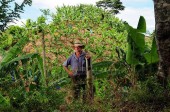
A rural peasant, photo for illustrative purposes.
Now, as peace becomes a reality, people here are trying to replace that tarnished past with perfectly legal cacao crops.
Getting to Guerima, a gateway to the Amazon region in the Vichada province, is an adventure in itself that requires landing at an improvised forest airstrip almost impossible to see from the air.
The unpaved landing strips were laid out by drug traffickers who used them for escape routes.
Just as the Antioquia natives did back in the 18th century with coffee beans in the central part of the country, Lehder called on settlers from all over the country to come plow the mountain and plant the leaf that was to make him rich.
The outlaw company took advantage of landless farmworkers and was so successful that coca paste became the local currency with people using it to buy and sell goods locally.
Some stores are still willing to accept coca paste for 4,000 pesos (some $1.30) per gram.
The system is on its way out, however, since the product has lost its value: A pack of cigarettes alone costs 3.5 grams or 5,000 pesos ($1.66), local residents told EFE.
“We haven’t accepted grams for a year now. If they don’t pay me in cash there’s no deal,” said Gian Hernando Garcia, who came to Guerima to become immersed in the culture of crime.
To bring coca production down from its high wheeling state required tough military action that ended with the extradition of Lehder to the United States in 1987, where he served a long sentence for drug trafficking, and then the death years later of Tomas Medina Caracas, alias “Negro Acacio,” considered the FARC’s leading drug kingpin.
Negro Acacio died just a few miles from Guerima in an air force operation, and the area was then defined by the military as a “gray zone,” a region with no enemy presence but not yet taken over by the Colombian government.
Then came the cacao crops. The beans are slowly replacing coca as a viable economic alternative.
At the height of coca production, the illegal crop is estimated to have covered some 7,400 acres (3,000 hectares), but by 2015 production was down to about 1,500 acres (600 hectares), and the Defense Ministry expects that by 2019 it will have disappeared completely.
By Gonzalo Dominguez Loeda, EFE



