


 SIGN UP FOR OUR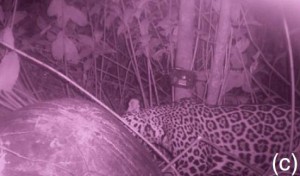
Rare Nighttime Photo of a Jaguar Predation of a Sea Turtle
Conservationists in Costa Rica are in a quandary over one endangered species’ newfound appetite for another threatened species. According to a recent study, researchers have observed a perplex situation unfolding in Tortuguero National Park in the province of Limon: jaguars voraciously feeding on marine turtles arriving during nesting season.
The study focuses on five species in Costa Rica: The predator is Panthera onca, known among Ticos as jaguar or puma depending on the region and pigmentation. The prey are four different species of marine turtles: baula, carey, lora, and verde (respectively in English: leatherback, green, hawksbill, and olive ridley). The marine turtles are seemingly easy prey for the jaguar, as evidenced by the 676 kills over a five-year period counted by researchers in Tortuguero. The hungry felines mostly dined on green turtles; although one rare leatherback kill was reported.
One more species was observed in the study: Homo sapiens; particularly the conservationists who symbiotically work with their beloved marine turtles in the north and sound ends of the lengthy, pristine beach in Tortuguero. Not surprisingly, jaguars are avoiding those two areas and concentrated on the central stretch of the beach.
According to the study, which was published in the current issue of Oryx: Fauna & Flora International (a Cambridge University journal), both marine turtles and jaguars are considered flagship conservation species. This means that these animals are important for the marketing of certain factors that make Costa Rica irresistible to conservation workers, ecotourists, scientists, etc. Marine turtles and big cats in Costa Rica have reached iconic status for many reasons. Looking back at the number of articles that The Costa Rica Star has published on felines and marine turtles, it is easy to see that there is a marked interest in their conservation.
Herein lies the dilemma: How much of an anthropogenic effect is impacting the jaguars? They are opportunistic predators, and the researchers posit that “it is not possible to dismiss the potential impact as insignificant given the total number of adult turtles predated and the annual increase since our study began.” The paper also cites a previous study in Nicaragua, where the turtles were subject to heavy poaching activity, thereby reducing the jaguar population.
As a conclusion, the researchers offered the following:
The responsible authorities in Costa Rica may soon be faced with a management dilemma.
Conservationists need therefore to be aware of the potential trade-offs involved in the use of flagship species to market biodiversity conservation.
It comes down to humans to gauge the impact of their conservation effort on on other species. Human activities in Tortuguero are having an impact on the ecosystem, but with careful planning the impact can be managed accordingly to benefit all species.
The full paper can be obtained from Cambridge Journals. The photo above comes from the same paper:
D . Verissimo, D. A. Jones, R. Chaverry and S . R . Meyer (PDF, 8 pages)
Source: Phys.Org



