


 SIGN UP FOR OUR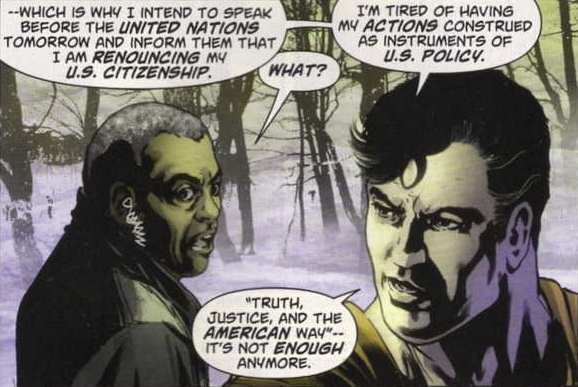
Pictured above is Superman renouncing his American Citizenship in the 900th issue of Action Comics.
What would move an American expatriate residing in Costa Rica to renounce his or her citizenship? Would it be FATCA, or the proposed passport restriction on owed taxes?
What about a Canadian citizen, could he or she do the same?
The questions above come to mind as the co-founder of online social network Facebook made headlines earlier this week when news media outlets reported that he renounced his United States citizenship. Eduardo Saverin, who is Brazilian and currently resides in Singapore, stands to make millions when the scheduled Initial Public Offering (IPO) of Facebook takes place next week on Wall Street.
Author’s Note: The use of the noun and adjective “American” in this Article conforms to the definition in Princeton’s WordNet: (A native or inhabitant of the United States), and the recommendation by the Associated Press Stylebook: (An acceptable description for a citizen of the United States). Natives and inhabitants of North, Central and South America are also Americans.
It seems that many things are happening on the run-up to the one of the most anticipated IPOs in history. Microsoft, for example, pledged the allegiance of its flagship search engine Bing to Facebook earlier this week -and it chose Costa Rica to illustrate it. Also, Facebook’s CEO Mark Zuckerberg will turn 28 years old on Monday. But the renouncement of citizenship by Mr. Saverin’s de-friending of the United States is one of the most memorable events of the Facebook pre-IPO hysteria.
In a strongly opinionated piece in Forbes magazine, John Tamny -who is a Forbes staffer- called Mr. Saverin an American hero for his renouncement. Other media outlets have taken a different view, calling the renouncement a weasel move. Mr. Tamny explains his point:
Saverin’s flight from the U.S. is yet another reminder of the superiority of a national consumption tax that in a perfect world would be implemented in concert with the abolition of the I.R.S. A limited federal government is a difficult concept to achieve so long as that same government can grant itself the legal right to tax a certain portion of our incomes. When individuals resist governmental hubris, we should exalt their actions.
In essence, Mr. Tamny sees Mr. Saverin’s renouncement and shielding of assets as a patriotic act of civil disobedience. If the national consumption tax that Mr. Tamny mentions sounds familiar to readers of The Costa Rica Star, it might be due to the commentary once made by Patricia Perez Hegg of the Libertatian Movement. She is in favor of a flat tax for all consumers in Costa Rica.
To an extent, Mr. Saverin’s renouncement can be considered more as a matter of convenience than ideology, although Mr. Tamny sees the opposite. Mr. Saverin is not completely off the hook, however, as renouncing American citizenship for tax purposes has the following caveat:
TAX & MILITARY OBLIGATIONS /NO ESCAPE FROM PROSECUTION
Also, persons who wish to renounce U.S. citizenship should also be aware that the fact that a person has renounced U.S. citizenship may have no effect whatsoever on his or her U.S. tax or military service obligations (contact the Internal Revenue Service or U.S. Selective Service for more information). – From the U.S. State Department.
Mr. Saverin can avoid payment of future taxes, but not previous taxes.
Let’s look at other famous Americans, by birth or naturalized, who have renounced their citizenship in the past:
- Robert Vesco – fugitive financier and white-collar criminal who was given safe haven in Costa Rica in the 1970s.
- Silent film star Charlie Chaplin
- Michael Dingman – former director of iconic American company Ford Motors
- John Dorrance III – heir to the Campbell Soup riches
- Yul Brynner – famous actor in biblical films
- Superman – in the 900th issue of Action Comics
Renouncing American citizenship usually takes place at an embassy overseas, and such request can be denied under some circumstances. Requests for renouncements usually spike around tax time in the United States.
Canadian citizenship may be more difficult to renounce, according to section II(9)1(a) of Canada’s Citizenship Act:
Renunciation of citizenship
- 9. (1) A citizen may, on application, renounce his citizenship if he
- (a) is a citizen of a country other than Canada or, if his application is accepted, will become a citizen of a country other than Canada;
- (b) is not the subject of a declaration by the Governor in Council made pursuant to section 20;
- (c) is not a minor;
- (d) is not prevented from understanding the significance of renouncing citizenship by reason of the person having a mental disability; and
- (e) does not reside in Canada.
The requirements above add one more caveat to the renouncement process, at least when compared to the United States. Former Americans are allowed to become stateless, whereupon Canada would not allow her citizens to fall into that category.



