


 SIGN UP FOR OUR
 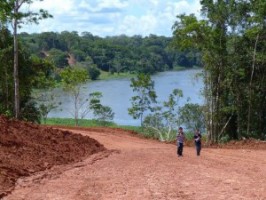 Foreign Minister Enrique Castillo this week told lawmakers of the Legislative Assembly’s Public Expense Committee that to “demonize” the border road dubbed with the number 1856 is to play into Nicaraguan hands.
He characterized the troublesome road as a defense measure against the aggressive aims of the government of Nicaraguan President Daniel Ortega whose troops briefly occupied Calero Island in Costa Rican territory in October, 2010.
But he strenuously denied Nicaraguan charges that construction of Route 1856 along the southern banks of the San Juan River has damaged the river at all. He said he had sent three diplomatic notes to Managua refuting Ortega’s accusation but had received no replies.
The Nicaraguans can prove no damage to the San Juan because their isn’t any to prove, he said. It is one thing to cause short-term, correctable damage and another to destroy the river, he said.
Castillo claimed that criticism by Tico and the press of the border route provided ammunition for Ortega’s propaganda. Nicaragua has filed accusations of environmental damage against this country, stemming from road construction.
The Foreign Minister admitted that errors had been made in building the road without prior plans or an environmental impact study. (See previous articles.) “We must not permit these errors to demonize the route,” he said.
But he brushed aside the environmental damage, saying that, “If you have to cut a tree you have to defend yourselves.” He characterized the trouble road as the most important defense project in many years.
The road construction followed the incursion of Nicaraguan soldiers on to Costa Rican territory. Fore many years, Costa Rican border communities have been only accessible by boat on the San Juan River, by treaty Nicaraguan territory. The road is to link those communities by land vehicles.
It is one thing, said Castillo, to investigate wrongdoers, referring to official investigations by prosecutors into allegations of private contractors bribing Conavi, the highway construction agency, and another to criticize the road itself.
Commentary: We have referred to the border road as President Chinchilla’s Watergate and Castillo’s vehemence will not cause us to change our minds. The press, especially the crusading newspaper La Nacion, has turned up instances proving that the project was unplanned and riddled with corruption.
It appears that Castillo was sent up the hill to the congressional committee to try to mitigate the damage by covering it with the flag. It is not the criticism that has weakened the Costa Rican case in the World Court, it was the unseemly haste in which the road was constructed.
Castillo is using the tired old “if you aren’t with us, you’re against us” tactic. It won’t quiet the press nor will it stop the free speech in this country.
Update: Meanwhile the bad news continued to pour in about Route 1856 as investigators turned up instance after instance of questionable practices. Last Wednesday La Nacion reported that Conavi spent more than two billion colones in contracting five companies and an individual, all of whom had never been contracted by the government before and had no machinery for the job.
At least two of those contractors went on a 2011 junket to Florida with Conavi officials, showing a certain chumminess one ordinarily does not expect of contracting officials with suppliers and building companies.
Moreover, Conavi executive director Jose Luis Salas, circulated a directive among his employees June 5 reminding them of their “duty of confidentiality” which included a threat of firing them without rights for violation.
While this undoubtedly would impede the press from getting more information on irregularities, it will most certainly not keep employees from talking to official investigators. A copy of the document was immediately leaked to the satirical news blog “El Infierno en Costa Rica.”
But Salas told La Nacion that “This circular is related to technical or strategic subjects and not to anything strange. The document does not intend to gag anyone…” (An employee reading the circular might find any other interpretation is difficult to imagine.)
Minister of Public Works Luis Liach said he was unaware of the circular and denied any attempt to gag charges of corruption. It appears, however, that circulation of the document was approved by the Conavi board of cirectors.
President Chinchilla’s Information Minister, Francisco Chacon, said when he heard about the directive, he contacted Conavi for an explanation. Well he might, because Article 81 of the Constitution guarantees access to public information except that which is necessary to national security.
The last president to try to clap the lid on public information was Luis Alberto Monge in the 1980s who called a report on the results of his agriculture program a “state secret.” It didn’t work then.
But the gag order does not apply to employees of individual road construction contractors and sub-contractors such as bulldozer jockey Carlos Vega. He told La Nacion that his employer told him to “steal five hours of time for doing absolutely nothering.”
His employer at the time, Mario Araya, denies he have any such instruction. That Vega was aware of the ethical implications of billing bogus hours is shown by his choice of words, “robar” (steal), for the billing of work not done.
Araya was one of the sub-contractors with especially cosy relations with Conavi officials who billed the government 150 million colones for work done on Route 1856.
Another instance reported by La Nacion was the case of Juan Agustin Quesada who assigned his truck to contractor Giovanni Baralis to carry materials to the road site. The trip, he told OIJ judicial investigators, took only two hours, but Baralis instructed him to haul only twice per day and bill for 10 hours’ work, Quesada said.
“The rest of the time, we whiled away sleeping or sitting beside the road to complete the 10 hours,” Quesada was quoted as saying. Baralis billed Conavi 1.35 billion colones at 24,000 colones per hour for some very expensive naps.
Another subcontractor, Giovanni Blanco, told La Nacion that if it rained, as it does frequently in the area, he could not operate his excavator. He said that no Conavi official was around to supervise, so he assumes his employer billed for 10 hours of work.
Source: fijatevos.com



