


 SIGN UP FOR OUR
  Recently, Julia VanTieghem – New York-based coordinator for the Rainforest Alliance’s major gifts’ team – had an opportunity to travel with colleagues to Costa Rica to see firsthand the benefits of the Rainforest Alliance’s work on farms, forests and hotels. She writes…
Our home base for the week was a hotel that has worked with the Rainforest Alliance to put good environmental and social practices in place.
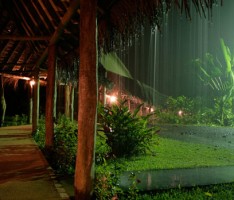
Hotel Sueno Azul felt like an oasis within the rainforest in the Sarapiquí region of Costa Rica, located about two hours across the continental divide from San Jose. To reach the remote location, our tour bus lumbered down a dusty road through farms and dropped us at a footbridge to cross over a river onto the hotel property.
The hotel was far less rustic than its isolated location might suggest — we enjoyed a full-service open air restaurant and bar overlooking a pool and lagoon. Each room had air conditioning and private bathrooms, demonstrating that ecotourism doesn’t always mean roughing it.
The air conditioning had me skeptical about the hotel’s sustainability credibility, until the owner started explaining all of their efforts. The hotel employs mostly workers from the local town and contributes funding to the community elementary school. It also founded a women’s association, whose members tend a botanical garden — using ingredients from the garden to craft natural soaps and other products used in the hotel spa — and make jewelry to sell in the hotel store. Local women now have an independent source of income and an improved sense of self-confidence.
On the environmental side, a solar dryer for laundry — which looks like a greenhouse from the outside — cuts down on energy usage. The hotel has also begun monitoring its electricity usage so it can identify areas of improvement.
Most importantly, the hotel property includes more than 700 acres (294 hectares) of protected forestland. Together with several sustainable lodges in the area, Hotel Sueno Azul is conserving important forests to create a buffer zone adjacent to the Braulio Corillo National Park and extending biological corridors where wildlife can roam. On nature walks, and just hanging outside our hotel rooms, we saw an armadillo, a chameleon, a tarantula, howler monkeys, wild horses, toucans, little frogs, and lots of other birds. The local biodiversity also offers an added benefit: a healthy bat population mostly keeps the mosquitoes at bay.
While tourism may not jump to mind as a path to environmental conservation, the small actions of hotels like Sueno Azul do add up. Lodges and hotels offer a great source of jobs and income in small communities, without having to clear forestland. You can find eco-friendly lodging options throughout Latin America on the Rainforest Alliance’s satellite website, SustainableTrip.org.
Source: Frog Blog



