


 SIGN UP FOR OUR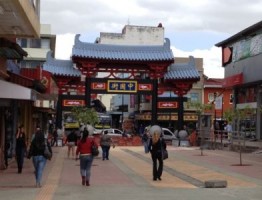
Source: Wikimedia Commons
Later this year, Costa Rica’s Barrio Chino (Chinatown) will celebrate its second anniversary of having taken over the old Students’ Boulevard as a token of appreciation for the kind donation by the People’s Republic of China (PRC) of the majestic National Stadium in La Sabana Metropolitan Park. The pretty paifang (Chinese gate) that marks the entrance to Chinatown from San Jose’s busy Second Avenue is supposed to bring good fortune to this commercial district; alas, a recent report by Luis Diego Marín of news daily La Prensa Libre indicates that luck is hardly on the side of shopkeepers here.
Many business owners report that sales have dropped by as much as 50 percent since Chinatown was inaugurated. Foot traffic has been drastically reduced due to the relocation of several bus stops that connected commuters with the southern suburbs of San Jose. Most of the action takes place in the section just past the Second Avenue paifang, where the historic La Soledad (The Solitude) church is located; this is where tourists have their picture taken next to a sculpture of John Lennon sitting on a park bench, and they can visit the galleries in the cozy Plaza of the Arts.
There are also complaints about vandalism and street-level drug taking place in Chinatown after Fuerza Pública (Costa Rica’s national police) stops their foot patrols late at night. The strongest complaint, however, is flooding. It does not take torrential rains for Chinatown to flood; even moderate August rains will turn this commercial district into a swimming pool. A drugstore owner complains that he has suffered major loss of merchandise on two occasions due to the poor drainage system. Oddly enough, the San Jose Municipal Council building is located just 50 meters away from Chinatown.
The Costa Rica Star first reported on this issue a year ago; below you can find the original article:
When the People’s Republic of China kindly donated the design, materials and fine workmanship to build the new National Stadium of Costa Rica, a much talked-about topic of conversation revolved around whether the planned Chinatown neighborhood in San Jose would be an appropriate token of gratitude. According to Alonso Mata of La Nacion, Costa Rica is falling way short in this regard.
Alonso Mata Blanco is a sharp blogger and a scholar of all things pertaining to the lovable city of San Jose. He recently took a stroll through the very quiet pedestrian boulevard of Chinatown and saw major problems; namely:
- For a Chinatown, the neighborhood is not very Asian.
- For a commercial district, Costa Rica’s Chinatown is desolate to the point of merchant desperation.
- Flooding is rampant. It happens every time it rains, which means every other day during the green season.
- Rats have become quite comfortable therein.
If you read Spanish, or simply wish to see recent pictures of the flooded streets of Chinatown and its sizable rats jovially carrying on next to doves and pigeons, please click here. The analysis by Mr. Mata is masterful; what follows is but a synopsis.
Chinatown has major problems. We are not talking about Asian Triads, either -those are seemingly operating in other parts of Costa Rica. In a way, we can say that the most significant problem is the flooding, which sends shopkeepers scrambling to find brooms and mops in an effort to protect their merchandise. The problem is largely of perception; to wit: The National Stadium and its ultra-efficient drainage system.
Two recent major sporting events have tested the drainage system of the natural grass pitch of Costa Rica’s National Stadium, which Chinese engineers and construction laborers completed in record time. Just before the historic victory by the National Football Team of Costa Rica against their counterparts from the United States, it rained cats (rats?) and dogs on the Central Valley. The natural grass pitch at the National Stadium turned greener and prettier while the streets of Chinatown got flooded. The pitch at La Sabana drained in about 25 minutes while the water at Chinatown was ankle-deep.
A similar situation occurred more recently; during the hours leading up to El Clasico, the match between the First Division football teams Deportivo Saprissa and Liga Deportiva Alajuelense, it rained copiously over the Central Valley. Did any of the players slip on wet grass? Hardly; once again, the pitch drainage system worked like a charm.
What does the above say about Costa Rica’s attempt at being commensurate? Does Chinatown measure up to the National Stadium?
In his blog post about the situation in Chinatown, Mr. Mata explains that the Municipality of San Jose is well-aware of the big rats scurrying about the pedestrian boulevard and scaring tourists and passerby. These rodents would much rather remain in the underground pipe system, but they are not aquatic animals. Should they remain down there, they would surely drown; thus, they come up for air and enjoy the company of the pigeons.
Mr. Mata finished his thoughtful blog post with a glimmer of hope: The residents of Chinatown, predominantly non-Asian merchants, are fed up with the situation and have vigorously complained to the Municipality of San Jose. With former Mayor Johnny Araya as the shoo-in candidate to succeed President Laura Chinchilla, there is a chance that Chinatown will one day be an adequate token of appreciation to the People’s Republic of China.



