


 SIGN UP FOR OUR
 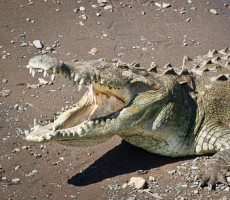 A tourist from Montreal who visits Costa Rica each year to enjoy surfing was unexpectedly attacked by a caiman (crocodile) while waiting for a set. The attack occurred last weekend in Tamarindo Beach, a coastal community that is home to many North American and European expats.
According to a news report filed by Pablo Rojas of online news daily CRHoy.com, the Canadian surfer was sitting on his board and looking at the incoming waves when fellow surfers warned him about the proximity of the caiman in the surf; alas, the warning did not give 44-year old Val Muscalu enough time to react. The reptile delivered a deep bite to Mr. Muscalu’s left foot, which was dangling from his board; fortunately, the caiman’s sharp teeth did not penetrate deep enough to reach its victim’s tendons.
The doctor who treated Mr. Muscalu explained that it took his patient about seven days to fully recover from the bite before returning to Montreal.
As it happens, Mr. Muscalu is not the first surfer to be attacked by a caiman in Tamarindo Beach. As reported by The Costa Rica Star in November 2013:
A rare attack by a cayman on a Spanish couple as they enjoyed surfing in Costa Rica has had a detrimental effect on tourism. The attack, which took place on October 13th, was widely publicized in several media outlets and became a viral item that was shared across online social networks. Days after the reptilian-human scuffle, residents of Tamarindo Beach noticed that the sand and surf of their community were missing a crucial element: Tourists.
In October 2014, an agricultural engineer was attacked by a caiman at the National Technical University in Atenas. That attack was the third unpleasant encounter between caimans and humans in Costa Rica over a period of just a few weeks. Conservation officials in Costa Rica have warned residents in some communities that the caiman overpopulation is due to an adjustment in the reptiles’ migration patterns due to climate change.



