


 SIGN UP FOR OUR
 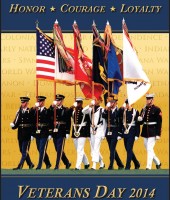 The United States today celebrates Veterans Day, and in Costa Rica the American expat community often gathers to celebrate those who served their country’s Armed Forces.
Author’s Note: The use of the noun and adjective “American” in this article conforms to the definition in Princeton’s WordNet: (A native or inhabitant of the United States), and the recommendation by the Associated Press Stylebook: (An acceptable description for a citizen of the United States). Natives and inhabitants of North, Central and South America are also Americans.
The abolishment of a military force in Costa Rica prompts some Ticos to serve in armed services abroad, particularly in the United States. In the past, The Costa Rica Star has reported on some of these brave Ticos who took the oath of service in the U.S. Armed Forces, and who bravely fought and honored their oath, sometimes with the ultimate sacrifice.
The American Legion Post in Escazu is named after Sergeant First Class Raymond Edison Jones, Jr., United States Army, who was killed in action in Iraq. SFC Jones was a high-ranking non-commissioned officer in the U.S. Army’s 1st Battalion, 7th Field Artillery, 1st Infantry Division. He died in 2004 when his unit came under attack by an enemy rocket-propelled grenade, a weapon that was a staple of urban warfare in Iraq. The surviving parents of SFC Jones are from Costa Rica, and his mother still lives here with his younger siblings.
Here are the stories of three young men from Costa Rica who served in the United States Armed Forces; two of them were killed in the line of duty. Their service is deeply appreciated by the American people.
Lance Corporal Alexander Scott Arredondo, United States Marine Corps
Carlos Arredondo left Costa Rica for the United States as a young adult in search of better economic opportunities. He settled and began raising a family. One of his American-born children, Alex, made a brave decision to join the United States Marine Corps at the tender age of 17. Carlos was initially reticent about Alex’s career choice, and he did not sign the necessary paperwork for his underage son to join. Alex’s mother, however, contributed her signature and soon Alex was on his way to boot camp in Camp Pendleton. Carlos then decided to support his son and applaud his patriotism and courage, even as he left to fight in Iraq.
On August 25th of 2004, Carlos’ birthday, he was at home in Miami while Alex’s grandmother baked a cake. Carlos wanted to get a phone call from his son in Iraq, but instead he got a knock at the door from three solemn Marines decked out in full dress blue uniform regalia. The Marines delivered some very sad news to Carlos: his son, Lance Corporal Alexander Scott Arredondo had been killed by an enemy sniper in Baghdad. The shock of the news drove Carlos to lose his mind and set fire to the vehicle the Marines arrived in, suffering severe burns to half of his body. Once he was released from the hospital, Carlos apologized for his irrational actions and avoided being charged with arson.
These days, Mr. Arredondo is a pacifist, antiwar activist and a hero: He was a first responder in the 2013 Boston Marathon, and he sprung to action to help victims of the abominable terrorist bombing.
The Costa Rica Star took a closer look at the tragic story above in the article: How the Iraq War affected two Tico families, published in 2011 as the American troops were leaving Iraq.
Camilo Mejía, Florida Army National Guard
As the first Iraq war veteran to take a pacifist stand against the conflict, Staff Sergeant Camilo Mejía’s story is a shining example of pacifism as an article of faith. Camilo was born in Nicaragua, the son of a famous folk singer who penned songs for the Sandinista revolution. His family later settled in Costa Rica, leaving the violence in their country for a tranquil life in a new peaceful land.
In the mid-1990s, Camilo found himself studying at the University of Miami. He joined the Florida Army National Guard, taking advantage of a scholarship. His unit deployed to Iraq in 2003, and while on leave in the United States after completing a tour of duty, Camilo became a deserter and filed for conscientious objector status. The basis for his claim was that he foresaw the human rights violations that would later be known to the world as the Abu Ghraib prisoner abuse scandal.
Camilo was detained by the United States Army and indicted on serious charges. Under the Uniform Code of Military Justice, desertion in time of war could have lead to his execution. Camilo fought the charges and stood his ground, gaining the support and respect of several anti-war organizations. He was convicted at a court martial and spent one year in military prison. Amnesty International strongly denounced Camilo’s incarceration, admonishing the U.S. military and the George W. Bush administration.
Camilo’s court martial draw the attention of the international law community, since as a Costa Rican citizen Camilo could not be forced to prolong his military service to the U.S. In the end, Camilo was vindicated. Abu Ghraib and many other horrors of the Iraq war were exposed, and he received many awards for his peaceful convictions. Camilo is the author of Road from Ar Ramadi: The Private Rebellion of Sergeant Camilo Mejia.
Staff Sergeant Andrew Trevor Britton-Mihalo, United States Army
Staff Sgt. Andrew Trevor Britton-Mihalo was born in San Jose, Costa Rica and raised in Simi Valley, Ventura County, California. He was 26 years old and is survived by Jesse Britton, who is also an enlisted non-commissioned officer (NCO) in the United States Army.
The incident in which Staff Sgt. Britton-Mihalo was killed resulted in the death of an Afghan translator and two other members of the coalition forces in Afghanistan. The attacker was a member of Afghanistan’s security forces, and he was assigned to an elite unit whose members are trained by NATO instructors.
Staff Sgt. Britton-Mihalo was engaged in a night raid along with other special forces soldiers, both NATO and Afghan. At some point during the operation, an elite Afghan soldier opened fire on his own patrol element. The attacker was killed at the site.
The Costa Rica Star reported on Staff Sgt. Britton-Mihalo’s unfortunate death and the troubling incidence of “green-on-blue” attacks in Afghanistan, where tension and cultural differences among Afghan and NATO soldiers are believed to be at the root of ghastly practices such as fragging and shootouts in which the enemy is not involved.



