


 SIGN UP FOR OUR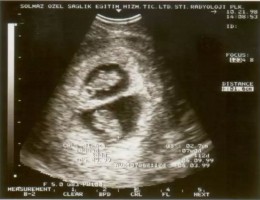
Twin ultrasound. Source: Wikimedia Commons
Earlier this year, a couple from Tabarcia, a semi-rural and suburban community in the province of San Jose, arrived in the San Juan de Dios Metropolitan Hospital with high hopes of experiencing the delivery of twin baby girls. This expectation was based on five ultrasound imaging procedures, which showed Ms. Leidy Ureña was pregnant with two girls. Ms. Ureña underwent a cesarean section, which resulted in a surprising revelation as only one baby girl was found in her womb.
The case of the missing, or vanishing ghost, twin has been dominating news headlines in Costa Rica over the last few weeks. Many questions have been posited in this case, which the obstetrics and medical imaging community finds fascinating since it recalls a 2013 scientific paper published in the Fetal Diagnosis and Therapy Journal:
Mirror artifacts in obstetric ultrasound; case presentation of a ghost twin during the second trimester ultrasound scan
We report a mirror artifact in a patient with a singleton gestation at 18 weeks. The image was interpreted as consistent with a twin gestation using transabdominal and transvaginal ultrasound. The differential diagnosis consisted of an abdominal heterotopic pregnancy. The presence of synchronized but opposite movements of both fetuses, and the blurred image of the second fetus, suggested a mirror artifact.
Mirror artifacts are produced by the reflection of ultrasound waves after they propagate through a structure and encounter a strong and smooth interface capable of acting as a mirror. Ultrasound waves bounce back and forth between the mirroring interface and the reflective object and then eventually return to the transducer. The typical display of the mirror artifact consists of two similar structures separated and at a similar distance from the reflective interface.
As can be imagined, Ms. Ureña and her partner Carlos Amador were filled with consternation when only one baby girl was delivered by Cesarean section. They have filed legal complaints against the hospital, which is administered by La Caja, the public and universal health care system of Costa Rica. The Office of Judicial Investigations is looking into the case as well, and things got really complicated when a medical report from the National Children’s Hospital, which is located next to the San Juan de Dios, allegedly suggested that a twin baby girl actually developed to full term but did not survive the Cesarean section.
It so happens that the medical report by the Children’s Hospital does not come to any conclusions about a deceased twin baby girl. The transcript, which has been examined and investigated by Lady Rojas and Angie Guerrero of online news daily Costa Rica Hoy, features the testimony of the mother, who firmly believes that the vanishing twin may have not survived the delivery.
The situation above has psychological undertones of a quasi-Munchausen by proxy syndrome, except that in this case there is actually no child being abused. Ms. Ureña took her baby girl to the Children’s Hospital because of signs of jaundice. As explained by the National Institutes of Health in the United States:
Munchausen syndrome by proxy is a mental illness and a form of child abuse. The caretaker of a child, usually a mother, either makes up fake symptoms or causes real symptoms to make it look like the child is sick.
In this case, the ghost twin suggested by the mirror artifact in the ultrasounds of Ms. Ureña caused her, her partner and medical staff to prepare for twins to arrive. Such was not the case, and now members of the medical and legal community in Costa Rica have a perplexing situation to deal with.



