


 SIGN UP FOR OUR
  Clarito M. Barron, director of the Bureau of Plant Industry (BPI) said that while the US has given the Philippine government “an inkling” about granting local bananas access to its market, feasibility remains a sticking point.
“Of course we would want this, but look at what happened to our mangoes,” said Mr. Barron.
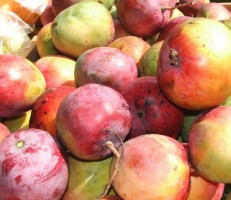
In 2001, the Philippines was granted the authority to export mangoes produced in Guimaras to the US by the latter’s Agriculture department.
Data from the Bureau of Agricultural Statistics (BAS) showed that there has been no mango exports to the US in the past five years.
“Our mango exporters stopped their shipment to the US for the simple reason that it is not competitive as compared to the South American mango, particularly Costa Rica, Ecuador, Puerto Rico,” he said.
The BPI official explained that freight costs would make these fruits less competitive.
“It will only cost the US $0.99 per kilo if the bananas were imported from South America, while bananas produced in Davao will cost them [sic] $4 per kilo,” said Mr. Barron.
He also said that the Agriculture department will still need to discuss with Washington various requirements before local bananas can be exported to the US, such as quarantine protocols and federal registration procedures. It will also need to conduct consultations with the local industry.
“As of now, we’re still in the process of doing all that. These may take some time. We still have to conduct a number of studies,” Mr. Barron added.
In a related issue, the BPI official also noted that banana exports to China dropped by about 90% following stricter quarantine measures imposed by Beijing on agricultural commodities coming from the Philippines after it found that several shipments of bananas contained scale insects.
According to the department, China now requires full inspection of all fruit shipments from the Philippines. Previously, Chinese quarantine officials only checked phytosanitary permits issued by Philippine quarantine officials.
“Before, we were exporting 16,000 metric tons (MT) every month; but as of May 25, this has dropped to 143 MT,” he said.
China, said Mr. Barron, is the country’s second biggest market for its Cavendish bananas after Japan, which is why the Agriculture department is “aggressively” looking for alternative markets.
Data from the Agriculture department showed that the Philippines exported 358.83 million kilograms of bananas to China last year worth $75.26 million in freight-on-board value.
“We have sent a trade mission to Israel, Egypt, Indonesia, Netherlands, Russia, Cambodia, Mongolia and other nearer countries to diversify the export market for Philippine bananas,” he said.
The official said that the department will follow up with embassies of these countries within the next few weeks in hopes of favorable responses.
Mr. Barron also added that Pakistan and Jordan have expressed “serious interest” in importing Philippine bananas, but declined to give any further details.
Source: Business World



