


 SIGN UP FOR OUR
Contamination and a dirty, unhealthy, environment are making children sick and causing their death worldwide; in Costa Rica, close to one thousand children under 5 years of age die as a consequence of this, the majority are due to respiratory infections. Yet, Costa Rica has better conditions than most countries in the world.
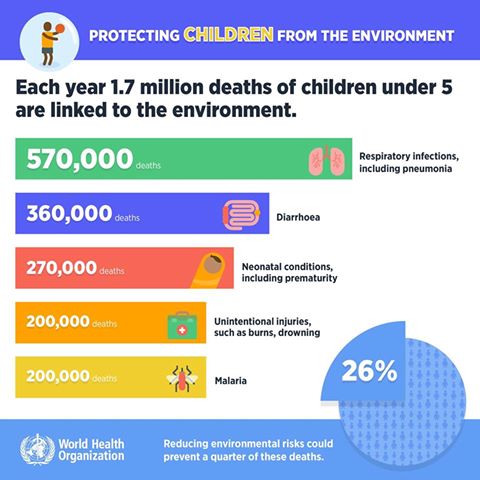
According to a report released by the World Health Organization (WHO) this past Monday, more than 1 in 4 deaths of children under 5 years of age are attributable to unhealthy environments. Every year, environmental risks – such as indoor and outdoor air pollution, second-hand smoke, unsafe water, lack of sanitation, and inadequate hygiene – take the lives of 1.7 million children under 5 years, say two new WHO reports.
The first report, Inheriting a Sustainable World: Atlas on Children’s Health and the Environment reveals that a large portion of the most common causes of death among children aged 1 month to 5 years – diarrhoea, malaria and pneumonia – are preventable by interventions known to reduce environmental risks, such as access to safe water and clean cooking fuels.
Data shown in the report by the World Health Organization establishes that an unhealthy environment is the cause of death of 20.21 children under 5 years of age for every 100,000 inhabitants in Costa Rica.
This number is actually low when compared to other Central American countries, for instance in Guatemala the number is of 89.15, Honduras registers 52.94 and El Salvador 47.48
“A polluted environment is a deadly one – particularly for young children,” says Dr Margaret Chan, WHO Director-General. “Their developing organs and immune systems, and smaller bodies and airways, make them especially vulnerable to dirty air and water.”
Harmful exposures can start in the mother’s womb and increase the risk of premature birth. Additionally, when infants and pre-schoolers are exposed to indoor and outdoor air pollution and second-hand smoke they have an increased risk of pneumonia in childhood, and a lifelong increased risk of chronic respiratory diseases, such as asthma. Exposure to air pollution may also increase their lifelong risk of heart disease, stroke and cancer.
Emerging environmental hazards, such as electronic and electrical waste (such as old mobile phones) that is improperly recycled, expose children to toxins which can lead to reduced intelligence, attention deficits, lung damage, and cancer. The generation of electronic and electrical waste is forecasted to increase by 19% between 2014 and 2018, to 50 million metric tonnes by 2018.
With climate change, temperatures and levels of carbon dioxide are rising, favouring pollen growth which is associated with increased rates of asthma in children. Worldwide, 11–14% of children aged 5 years and older currently report asthma symptoms and an estimated 44% of these are related to environmental exposures. Air pollution, second-hand tobacco smoke, and indoor mould and dampness make asthma more severe in children.
112 countries were part of this research, were Angola registers the most alarming numbers with 517.38 deaths for every 100,000 people.
Top 5 causes of death in children under 5 years linked to the environment
A companion report, Don’t pollute my future! The impact of the environment on children’s health, provides a comprehensive overview of the environment’s impact on children’s health, illustrating the scale of the challenge. Every year:
570 000 children under 5 years die from respiratory infections, such as pneumonia, attributable to indoor and outdoor air pollution, and second-hand smoke.
361 000 children under 5 years die due to diarrhoea, as a result of poor access to clean water, sanitation, and hygiene.
270 000 children die during their first month of life from conditions, including prematurity, which could be prevented through access to clean water, sanitation, and hygiene in health facilities as well as reducing air pollution.
200 000 deaths of children under 5 years from malaria could be prevented through environmental actions, such as reducing breeding sites of mosquitoes or covering drinking-water storage.
200 000 children under 5 years die from unintentional injuries attributable to the environment, such as poisoning, falls, and drowning. Source: World Health Organization / News release



