


 SIGN UP FOR OUR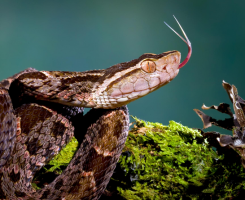
Fer-de-lance snake, found in the jungles of Costa Rica
By Carol Blair Vaughn
We should care about the Reptilian Top Ten. Here’s why:
Scientists from Oxford University (U.K.) and from Tel Aviv University (Israel) have created a top ten list of the world’s most popular reptiles.
You call this science?
It turns out, that it actually IS science. The research team discovered valuable information about how some animals fare better than others on conservation and endangered species lists. The authors of the top ten list were seeking to provide quantitative data regarding conservation priorities. You see, the cold-blooded critter most likely to be asked to dance at the prom, may be the one which survives extinction.
John C. Mittermier from Oxford University explains, “There is a debate in conservation as to whether the fact that we as humans like a particular species justifies conserving it, regardless of its importance from an ecological point of view.”
So the researchers involved in the study did what any prom-going high schooler would do – they hit up Wikipedia. They actually looked at all 55.5 million page views for 2014, of the over 10,000 reptiles represented in Wikipedia.
What they discovered was a special interest and fascination worldwide for venomous and endangered species, as well as those which pose a grave threat to humans. How sweet!
Some of the species on the top ten reptilian list can be found in Costa Rica, but they may not necessarily be native; in some cases they are migratory, have been introduced as exotic pets, or can be observed at sanctuaries such as Parque Reptilandia in Dominical or Snake World in Grecia. Only the Leatherback Turtle is safe to approach.
Here’s the list of the top ten cold-blooded creatures:
- Komodo dragon
- Black mamba
- Saltwater crocodile
- King cobra snake
- Gila monster
- Cottonmouth viper
- American alligator
- Leatherback sea turtle
- Nile crocodile
- Boa constrictor
Why should we care?
Here in Costa Rica, as in most of the world, popularity is a huge issue in the awarding of dollars for conservation efforts. Resources are so limited, and decisions must be made about how to allocate international and national funding. Popularity of a species could easily win out over an ecologically important or endangered species.
The number one reptile on the list (Komodo dragon) won with an all-time 2,014,932 page views for the year. This study was completed several years after the infamous Komodo dragon attack on the husband of Hollywood actress Sharon Stone at the Los Angeles Zoo, in which his big toe was completely crushed and several tendons severed. Stone’s husband survived, but unfortunately, the marriage did not.
Sometimes it’s hard for cold-blooded animals to get the press they need to stay on the Top Ten Reptile list.
About the Author
Carol Blair Vaughn holds a Master’s Degree in Performing Arts and is a retired college professor from Washington, D.C. She inherited her love for Latin America from her father, the former U.S. Ambassador to Colombia, Panama, and Director of the Peace Corps, Jack Vaughn. Carol writes for the Association of Residents of Costa Rica (ARCR) and for an English language club in the southern region of Costa Rica. In the past, Carol served as Editor in Chief of What’s on Tapmagazine.



