


 SIGN UP FOR OUR
 By Wendy Anders
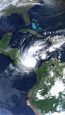
A satellite image of Hurricane Otto as it made landfall yesterday mid-morning.
After Hurricane Otto’s high winds and heavy rains lashed northern Costa Rica all day yesterday and most of last night, Costa Rica has all of its emergency personnel working at maximum capacity clearing roads, searching for possible disappeared persons, keeping shelters supplied, tallying of damages, and drawing up reconstruction plans.
Road damages alone have been estimated at almost US$8 million by the National Emergency Commission (CNE).
And though the hurricane has now passed into the Pacific ocean where it continues its seaward journey, unstable atmospheric conditions continue to prevail over Costa Rica, creating lingering uncertainty over possible further rains in areas already water-logged, said the National Meteorological Institute (INM) this morning in a televised statement.
Otto originated in the southwestern Caribbean as a tropical depression, and when it started to gather strength and speed, its initial westward path as a tropical storm and later as a hurricane became clearly delineated.
As such, Costa Rica focused it preventive work earlier this week on evacuating northern Atlantic communities where Otto was expected to touch down. After touching down in southern Nicaragua yesterday morning as a category 2 hurricane with very high winds, once on land, it was anyone’s guess how strong the hurricane would remain and the path it might take.
Otto ended up dumping huge quantities of rain in the low-lying Costa Rican agricultural communities of Los Chiles, Bagaces, and Upala along the Nicaraguan border. The National Meteorological Institute president in a broadcast statement this morning said that the district of Upala received the equivalent of one and a half months of rain average for this time of year in a lapse of just 6 hours. Bijagua, in the same northern region, received the equivalent of the entire month of November rains also in a 6-hour lapse.
The country has no record of such destructive flooding, said officials. Guanacaste was also drenched.
Police and emergency crews struggled through the downpours to clear blocked roads, and evacuated 2,500 people in the northern area of Bagaces, Los Chiles, and Upala. More work remains to be certain if there are still people stranded in areas that have been cut off by the floods.
Hundreds of police officials, judicial police, red cross, firefighters, and local emergency commission staff are working round the clock to contain the human impact of the storm, according to an official press report broadcast this morning from the National Emergency Commission headquarters.
The next 48 hours will be decisive in minimizing the human impacts of the severe flooding, said judicial investigative police (OIJ) director, Luis Guillermo Fonseca. The OIJ is responsible for providing official reports of any dead and disappeared. So far three people have been reported dead in Guayabo de Bagaces.
Emergency work actually began on November 16, said Ivan Brenes, the National Emergency Commission head, when flooding began in Costa Rica’s southern Pacific region. There are currently more than 5,500 people in 50 shelters in Guanacaste, Limón, and the northern and southern regions.
Work is being done to restore basic services including water and electricity, in the north as well as the south of the country. And reconstruction will begin as soon as possible so people can return to their homes and daily lives.
In the meantime, officials warned that nobody should attempt to return to flooded areas, and a red alert remains in effect for the entire country except the central valley region. The country’s densely populated central highland area (San José, Alajuela’s central region, Heredia, and surrounding towns) escaped the effects of the storm, except for isolated downpours.
An update on the emergency will be broadcast today at 5:00 p.m. when more details on the drama of this natural disaster will be available.
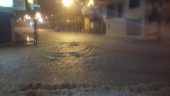
An image shared on Facebook of seawater invading Limon city last night due to the sea swells in the aftermath of Hurricane Otto.



