


 SIGN UP FOR OUR
 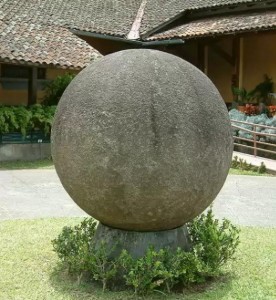 You have seen them proudly adorning many of our historical landmarks, such as the National Museum, our Judicial Complex, the National Assembly, the Children’s Museum, and our Embassy in Washington DC. In the past, you may have also seen them unceremoniously used as lawn ornaments on the homes of powerful Tico families. Our solemn, gray petrospheres never fail to attract attention, and they will soon have their own national park.
In the Osa canton of the southern Brunca region in the Puntarenas province, the local community and officials from the National Museum are working together towards the grand opening of the second archaeological national park in Costa Rica. Francisco Corrales, director of the National Museum, explains that “this area presents evidence of an important pre-Columbian settlement. This will be future site of the Park of the Stone Spheres, a new archaeological landmark that will add significance to the candidacy of the Diquis Delta in becoming a World Heritage Site according to the United Nations Educational Scientific and Cultural Organization (UNESCO).
The announcement comes just a few weeks after archaeologists working with the National Museum discovered three new stone spheres in the Batambal dig near the Terraba River in an area overlooking the Diquis Delta and the Pacific Ocean. These three new spheres are smaller than four other spheres found in the same areas a few years ago. Two of the new spheres measure 25 centimeters in diameter, while the third one is just 16 centimeters. Aside from the spheres, the archaeologists also unearthed anthropomorphic sculptures and monoliths thought to belong to the Aguas Buenas and Chiriqui periods, from 300 to 1500 AD. As has been the practice in the last couple of decades, the unearthed petrospheres will be left in situ.
The Mystery Remains
Aside from the UNESCO nomination, the Park of the Stone Spheres will serve an educational and cultural purpose similar in scope to Stonehenge. Our ancient stone spheres are endearing archaeological artifacts that have captured the imagination of anthropologists, archaeologists, paranormal researchers, and even ufologists. In 2010, anthropologist John Hoopes from the University of Kansas performed considerable research on the spheres for the UNESCO. John Hoopes has become an expert on our cherished spheres, and he is aware of the substantial amount of interest given to the stone spheres.
In his evaluation of the petrospheres, John Hoopes is glad to play the role of mythbuster. In his popular website dedicated to the stone spheres, John Hoopes takes exception to the speculative work of individuals like Erich von Däniken in the 1970s, as well as Colin Wilson and Rand Flem-Ath in the 21st century. Hoopes refers to the theories posited by these authors and researchers -who have appeared in print, radio and television- as pseudoscientific. In his online introduction to his research, “Debunking the Mystery of the Stone Balls”, Hoopes explains that the spheres are indeed “monolithic sculptures made by human hands” that are not related to lost continents or ancient space travel.
In his FAQ page, John Hoopes admits that nobody knows for sure why the stone spheres were made. Many of the petrospheres have been moved and manhandled by disrespectful researchers and relic hunters. What is known about the spheres that have been left in place, as they will be displayed in the future archaeological park, is that they present certain alignments that resemble triangular shapes. This alignment was further augmented by the indigenous tribes of the region by somehow rolling the spheres on top of mounds.
Possible explanations for the spheres’ function or purpose -not endorsed by Hoopes- include decoration for tribal housing according to caste structure, or astronomical representations of celestial events that coincided with agricultural cycles. It is important to note that the Bribri people are considered to be the earliest astronomers of the Americas, and that Bekuo -the name of the Mars spacecraft that Franklin Chang-Diaz is working on, means shooting star in the Bribri language.
The Future Park
Researcher Alberto Sibaja once wrote about observations made in the 1990s about the triangular alignment of five spheres in Finca 6 of the Palmar District, the future site of the Park of the Stone Spheres. Sibaja considered the spatial relation and alignment of the five spheres and the two triangles they trace: “Such triangulation is hair raising. What else were the indigenous people of the Diquis capable of?”
Aside from the imposing and perfectly aligned stone spheres, visitors to the park will be able to walk on discovery trails, appreciate pre-Columbian pottery and sculpture, and an old banana plantation home that will be transformed into a historical museum.
The Stone Spheres in Popular Culture
Aside from the esoteric and extraterrestrial attributions given to our dear spheres, they have been given the Hollywood treatment in the initial and exhilarating action scene of the 1981 film Raiders of the Lost Ark. Director Steven Spielberg set the mood for the rest of the film with a memorable scene in which Indiana Jones, played by Harrison Ford, runs away from a giant petrosphere triggered by an ancient anti-theft device.
The stone sphere trap from Indiana Jones makes an appearance in just about every version of the popular Tomb Raider video game.
In the supernatural novel Damnation of the Werewolf, which is based in Costa Rica, author Clint Romag makes mention of the petrospheres in a passage of the book in which two characters stroll through San Jose:
“After a few blocks they reached a small park and in the center was a circular stone rock the shape of a giant ball about four feet in height.
‘There are a lot of these stone spheres in Costa Rica, many are kept in the museums. The Indians made them, but there are still questions on how they did it. The stones are perfect spheres and very smooth.’
Cameron rubbed the surface with his hand finding it smooth to the touch. ‘Interesting. I wonder how they did it?’
Antonio shook his head. ‘I don’t know. Maybe aliens made them.’ He laughed. After a few minutes, he led them out of the park.”



