


 SIGN UP FOR OUR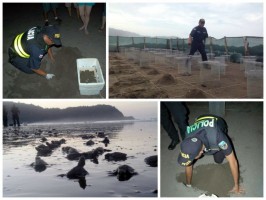
Source: Fuerza Publica
Earlier this month, the Ministry of the Environment (Spanish acronym: MINAE) in Costa Rica held the first in a series of workshops destined towards defining the next strategy for sea turtle conservation in our coastal regions. The Vice Ministry of Coastlines and Wetlands will be in charge of these workshops, which call upon various stakeholders to determine the current situations of these marine reptiles, which massively arrive year after year to nest in our country.
In Costa Rica, about 50 percent of the sea turtle nesting sites in the Pacific and Caribbean coasts are located within protected nature preserves. The objective of these workshops is to facilitate the exchange of ideas and experiences related to sea turtle conservation so that a new, master plan for conservation management can be applied in early 2016.
Scientists from domestic and international organizations attended the first workshop. There were members from academia, non-profit organizations, government, and community development associations present in this meeting. One of the first topics discussed in the workshop dealt with permits and collaboration. Vice Minister Fernando Mora explained:
At this moment, there are quite a few conservation, monitoring and protection projects at the local and national level. We need to have a space where we can learn about the work of these organizations, a space where we can discuss scientific and societal concerns as well as the challenges that these groups face. We need to know this so that we can formulate an adequate conservation strategy.
At this time, 60 sea turtle nesting sites have been identified in Costa Rica, and many of them are located within wildlife refuges such as Tortuguero, Las Baulas Marine Park, and Ostional. Between these three sites, five major sea turtle species massively arrive during nesting season, and they enjoy the protection of park rangers, volunteers, Fuerza Publica (the national police force of Costa Rica), and the National Coast Guard Service.
A major focus of the new conservation strategy will be on the remaining 50 percent of sea turtle nesting sites that are not within protected areas.



