


 SIGN UP FOR OUR
 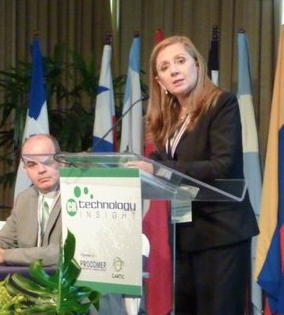 For the past eight years, Export Promotion Agency of Costa Rica (PROCOMER) and Costa Rican Chamber of Information and Communication Technologies (CAMTIC) jointly hosted the annual Costa Rica Technology Insight conference. This years conference is on June 19 and 20 in San Jose, Costa Rica.
Costa Rica Technology Insight (CRTI) draws participants from Panama, Central America, Dominican Republic, Trinidad & Tobago, Chile, Mexico, United States, Canada, Europe and India. The event focuses on networking, business meetings, and conferences, with the goal of creating new business opportunities for both national and international participants. During business meetings, the participants are matched with their Costa Rican counterparts to form business relationships.
As the regions most exclusive technology event, CRTI explores current trends in digital technologies. According to the CRTI Web site: “CRTI 2012 will open a window of opportunities for IT partners and end users looking for web applications and services, BPO (Business Processing Outsourcing), ITO (Information Technology Outsourcing), KPO (Knowledge Process Outsourcing), development of multimedia projects and digital animation, mobile applications, telecommunication mobile services, datacenters, business intelligence, design and development of vertical market applications (financial services, trade, health, tourism, government, etc.), call centers, contact centers, Cloud Computing, QA, testing, software development, e-learning, and many others.”
The digital technology industry directly employes more than 58,000 Costa Ricans. For the year 2010, the technology industry represented about 14% of the GDP for Costa Rica. The 2.8 billion dollars in exports represented about 30% of the export income for the country. Costa Rica has a diverse technology industry that can be roughly divided into the following sectors:
- Software development includes applications for every industry, operating systems, network software development, and database management software.
- Direct services include development and maintenance of applications, consulting, information technology outsourcing, network and telecommunications infrastructure integration and management.
- Enabled services consist of contact centers, data support centers, telemarketing, business centers and online purchase administration.
- Components is a broad category that incorporates hardware products, and other electronic devices.
- Telecommunications is critical sector that provides the basic infrastructure to all sectors.
- Digital animation and gaming is a growing industry for Costa Rica.
Digital technologies is a highly competitive sector. Costa Rica is a strong competitor in this sector both internationally, and within the Latin America region. As the CRTI Web site points out:
- Among the Latin America countries, Costa Rica ranks #3 on the Network Readiness Index (Global Information and Technology Report 2010-2011, World Economic Forum).
- Costa Rica hold the number #1 position as the most innovative country in Latin America (The Global Competitiveness Report 2011-2012, World Economic Forum).
- Costa Rica ranks #3 on the International Property Rights Index for Latin American countries (Property Rights Alliance 2011).
- Costa Rica ranks #5 for Global Service Locations in America (Global Service Location Index 2011, AT Kearney).
- San Jose, Costa Rica holds the #5 slot for top outsourcing cities in Latin America (Top 100 Outsourcing Cities 2010, Global Services).
- Costa Rica is the 4th largest high technology exporter in the world, and #1 in Latin America (World Development Indicators 2011, World Bank)
The Atlas of Economic Complexity: Mapping Paths to Prosperity is a major study done jointly by Harvard and MIT that measures a countries ability to achieve economic growth through the year 2020. The study covered 128 countries, and used a number of indicators to measure economic potential. The economic potential for Costa Rica is as follows:
- Economic Complexity measures the amount of product knowledge based on a countries export structures. Costa Rica ranked #49 in the world and #3 in Latin America.
- In terms of Economic Growth Per Capita GDP, Costa Rica ranked #38 in the world, and #6 in Latin America.
- In regards to Expected GDP Growth to 2020, Costa Rica ranked #34 in the world, and #4 in Latin America.
- The Change in Economic Complexity (1964 to 2008) looks at the past ability of a country to take advantage of its productive knowledge. For this measure, Costa Rica ranked #41 in the world, and #6 in Latin America.
- Costa Rica’s ranking in Expected Contribution to the World GDP Growth in 2020 reflects the small size of the country, and its limited labor pool. In this chart, Costa Rica ranked #81 in the world and #6 in Latin America.
The Costa Rica page in The Atlas of Economic Complexity reflects the tremendous growth in the digital technology industries from 1968 to 2008. Costa Rica is moving from an agriculture based in economy towards becoming a high technology based economy, when considering total exports.
The Atlas of Economic Complexity shows the potential for change. What happens in the next eight years depends on the ability of a country to actualize its potential for growth. The stability of the government in Costa Rica and its commitment to education play a big role in turning potential into acutalization. This is where Costa Rica has an advantage over most Latin American countries.



