


 SIGN UP FOR OUR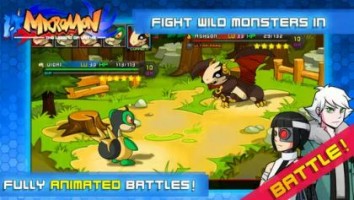
Source: MOGA
From a small office in San Jose, three video game developers are working on a project that involves an oddly-shaped character named Fenix (Phoenix, as in the bird from Arabian lore that self-ignites only to rise from the ashes anew) who will go endure many trials and tribulations to earn a cookie. At a larger studio across town, a development team is basking in the glow of seeing their ambitious game top the sales charts of mobile marketplaces in 10 countries.
Respectively, the two games mentioned above are: Fenix Rage; Get the Cookie, developed by Green Lava Studios, and Micromon, developed by MOGA (short for mobile games). The CEO of the former studio was recently interviewed by Rashid Sayed of online publication Gaming Bolt; the latter was profiled at length by Herberth Castro, a journalist who covers the video games industry for national newspaper La Nacion.
Fenix Rage: A Side-Scrolling Challenge
This is how Eduardo Ramirez of Green Lava Studios described Fenix Rage, his company’s work in progress, to Gaming Bolt:
We are building a very challenging, fast-paced and very fun [retro, 2D] platformer for our first major game.
We have more than 200 levels in Fenix Rage. There are different goals to beachieved in a level: getting a cookie, receivinga yellow star by going through the fastest path (time breaking records) and some [other] stars.
Mr. Ramirez also explained that his company hopes to bring Fenix Rage to the PC, Xbox One and PlayStation 4. This is not a casual game; it is an independent title that expands on the legacy of Nintendo’s Super Mario Brothers while injecting the difficult and addictive appeal of games such as Super Meat Boy. This is somewhat of a departure for what has driven the early video game development in Costa Rica, which has thus far focused mostly on the mobile, casual gaming market with titles such as Tweetland and the Angry Birds-like Pota-Toss.
The Micromon Universe
Whereas Fenix Rage may appeal more to hardcore gamers than casual players who enjoy a round of Candy Crush Saga while riding the train or the bus home from work, Micromon from MOGA is aimed at the more lucrative market of players who enjoy immersive games with social media features and fierce, real-time competition.
Micromon is going after fans of Pokemon, the Japanese Pocket Monsters universe currently owned by video game giant Nintendo. Just like in Pokemon, Micromon players find, tame and collect digital monsters that are generally cute and peculiar. This is where the similarities end; Micromon is far from being a Pokemon clone: the characters, games, challenges, backdrops, stories, music, and all other elements of the game are 100 percent original.
Alex Vemon, the main Tico game designer behind Micromon explained to La Nacion that:
“This is a game that tells the adventures of a player that is sucked into a video game that was mysteriously installed on his or her smartphone. The story takes place in the world of Pixekai, a digital game world whose inhabitants [Micro Monsters or Micromons] do not know about the real world at all; however, humans can enter this game universe by means of avatars, with one condition: That they never mention the existence of a world outside of Pixekai.
The adventure begins when the player learns of the giant, evil Micromon Vaithe destroyed an entire Pixekai village…”
To say that Micromon is ambitious is an understatement. This is the mobile game that Nintendo would have liked Pokemon to be had it been ported over to the Android mobile operation system or to iOS. Reviews of Micromon on the iTunes App Store have been very encouraging, and the game is 100 percent compatible with the Apple Game Center, which means that a player in Guanacaste could engage a player in Calgary in battle using the iPhone. Although Micromon costs just $0.99, MOGA is betting on cashing in on in-game purchases. The immersive, social and competitive nature of Micromon invites players to trick out their Micromons by means of buying digital items, although such upgrades can also be accomplished by repeated gameplay and accomplishing certain goals.
From Bootstrapping to Major Game Development
In the early 21st century, it was difficult to think that Costa Rica would one day become a significant player in the lucrative global video game industry. The Costa Rica Star has been following this burgeoning sector for years, and it seems as if the aspirations of local developers are maturing and coming to fruition.
For most video game developers in Costa Rica, the beginnings have been humble. Here’s part of the Green Lava Studios history as explained on their website:
“The story began in 2010 when Eduardo received an inheritance of $450 from his late great-grandmother. He decided to make this money count, and bought cheap software licenses (-$50), a web domain (-$10), 3 t-shirts with a logo on them (-$40) and registered “Green Lava Studios S.A.” as a game company… with a lawyer (-$300). ”
MOGA tried to go the Kickstarter route with Micromon, but it did not work. Some would-be donors unfamiliar with the cost of video game development balked at the $43,000 price tag. Although MOGA failed to reach its Kickstarter funding goal, the studio was able to meet investors and publishers who supported Micromon.
Although bootstrapping is bound to continue as the video game development industry continues to grow in Costa Rica, a few game studios other than the two mentioned herein have already matured. Take, for example, Happy Dog Games, a studio that has already developed titles for major clients, and which has been previously mentioned by The Costa Rica Star. There’s also Fair Play Labs, whose major clients include PlayFirst, Wild Tangent and Big Idea Games.
The video game development industry in Costa Rica may still be nascent, but it is certainly gaining solid momentum.



