


 SIGN UP FOR OUR
 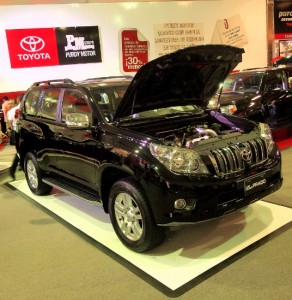 The Prado has been tried and true, but can it hold its identity as Toyota aims for the luxury SUV market?
It’s hard to see a 4×4 grow up. As the avid car lover I am, I hate to see the way they get fatter and less capable off road. Their interiors get filled with more and more extras like an overly complex entertainment system, heated seats with Thai masseuse mode and chilled cup holders; their exteriors inflate and shine under the sun from all the bling they carry now. Little by little, we see how they start losing their gritty personality to end up becoming a giant of the urban jungle.
Perhaps that’s why I still like the Land Cruiser Prado; if you look at it from a certain angle, it’s a rugged car that can get you from point A to point B in whichever way you please, and if you look at it from another, it’s a civilized, comfortable and safe SUV to take the kids to school and then do some shopping. This meant that when I got my hands on one, I was pretty excited about reviewing it.
First things first, I got my hands on the five-door model 3.0L turbo-diesel version. This longer five-door model has just been upgraded for this year’s Expomovil and looks to become the serious, mature choice for those looking for a great all-rounder. Having said this, I’ve always considered the three-door, 3.0L diesel to be the ideal 4×4 for the young, adventurous crowd: its short wheelbase, tough normally aspirated engine and capable transmission make it ideal for such uses.
Technical Data:
There are three trim lines in the Prado model range: the basic VX, the in-the-middle TX-L and the full VX-L. Note that the differences between the TX-L and the VX-L are very few–they vary from electric seats to steering wheel audio controls–, mainly focused on the engine of choice (TX-L models are available on both diesel and petrol while the VX-L comes only in petrol versions).
Theoretically, both engines have decent numbers to them: the diesel engine produces 161 hp and 400 Nm of torque while the petrol engine produces 270 hp and 381 Nm of torque. I tested the automatic transmission and found that its torque curve was pretty much constant, the turbo kicks in with very little lag and keeps going for the entire gear-range; this performance makes it great for off-road terrain. The petrol engine is refined and silent, it can move the Prado just properly but no matter how you drive it, you can’t get the mpgs to go up.
The Prado can come with as little or as much as you please, details such as a front parking camera, electronically controlled dynamic suspension and a windshield rain detector send the price rocketing skywards but provide a wide range of options to personalize your car. I for one always choose the basic models, less stuff inside means less stuff that could get damaged when you’re crossing rivers on the way to Ostional.
Is it cheap to run?
The Land Cruiser Prado is an expensive car, ranging from fifty thousand to up to eighty thousand dollars, but for that you get a good machine. Toyota has been known for their reliability and their Prado is a staple amidst 4x4s in Costa Rica. Since it’s considered a luxury SUV with big rims (17 and 18 inch rims) expect spares to be on the expensive side, but with proper maintenance, this car shouldn’t break down nor be a hassle.
Fuel consumption is where the balance shifts towards the diesel, in my opinion, since the numbers are pretty much one sided: diesel engines on the Prado will get you a combined performance 11 km/L (26 mpg) with 225 g/km of CO2. The petrol engines will give a combined performance of 7.5 km/L (17 mpg, ouch) and 271 g/km of CO2.
Can it climb walls?
Oh yeah, just ask these crazy South Africans (Ok, ok, not really a wall, but still pretty cool).
Where to?
From the beach to the mountains, from mud to the shopping malls, these guys have been everywhere.
Where can I get one?
Besides the dealership, the Prados can be easily found in most used car websites or newspapers. Their resale value is high so get ready to pay decent amounts for them. This, at the same time, is a great sign because it means that the Prado holds its value for the years to come. My personal choice is the three-door, 3.0L normally aspirated Prado from 2005 to 2009; get your hands on one of these and you have a car for life.
Final thoughts:
Let’s face it, the Prado can be considered an Everyday Joe. It might not bring luxury into play, it might not be exciting as the Porsche Cayenne or elegant as the Discovery, but truth be told, it doesn’t have to be. It still has proper off-roading skills, it still provides a reliable platform for hard work and it, for me, is a great car.



