


 SIGN UP FOR OUR
 The North American-Costa Rican Chamber of Commerce (AmCham) urged Costa Rican entrepreneurs to work within the U.S. government’s framework of expanding bilateral trade as Trump steers the U.S. away from multilateral agreements that have generated a trade deficit.


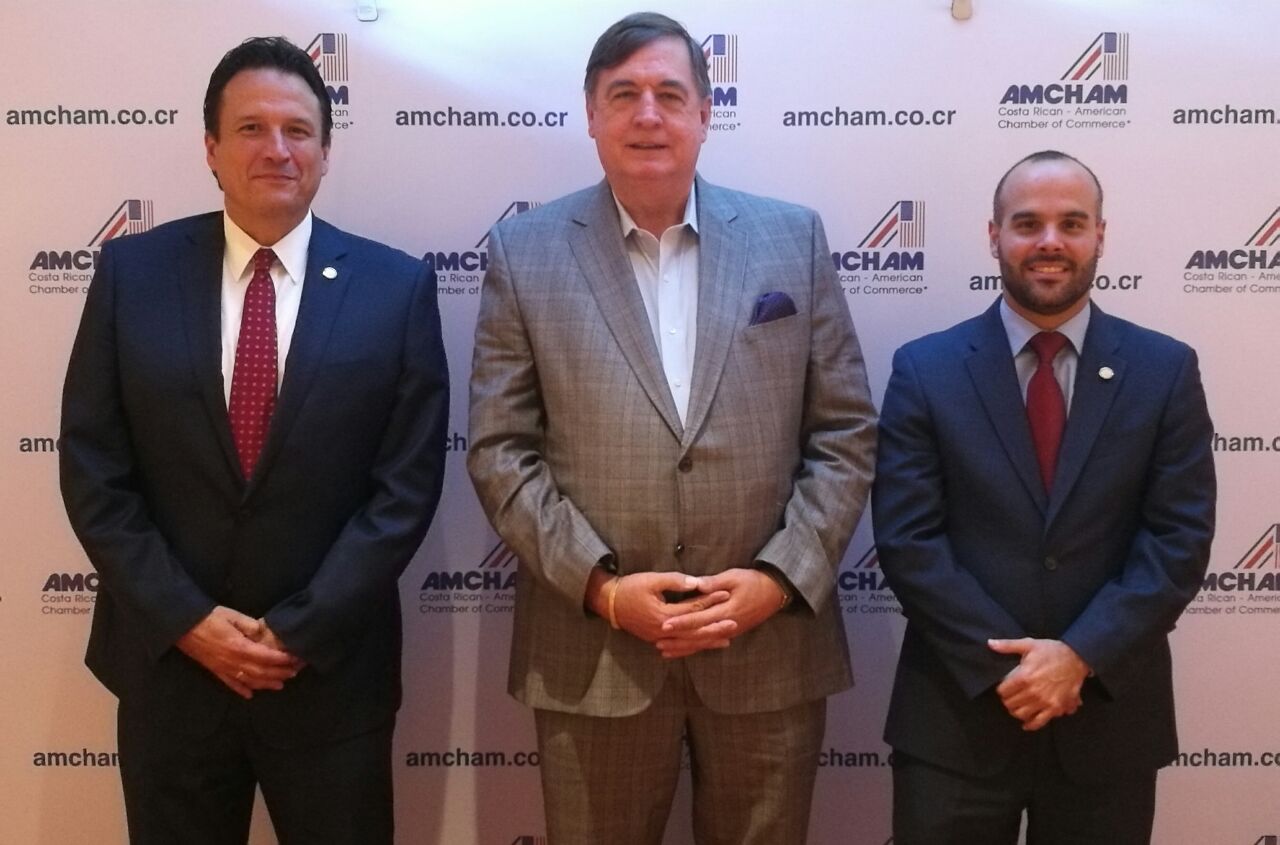
San José, April 28, 2017. On the Trump Administration’s 100th day, political and economic analysts the world over are sizing things up.
Costa Rica, with an economy highly tied to the U.S., is no exception, with AmCham leaders having met with the Costa Rican business sector today to provide an overview of the actions they believe need to be taken in light of global geopolitical and commercial paradigm shifts under Trump.
“Threats can be countered and opportunities can be exploited if leaders are informed and alert,” said the chamber in a forum this morning.
The analysis developed by the binational Chamber is based on President Trump’s stated agenda, and discussions by AmCham representatives with members of his administration during a recent trade mission conducted in Washington D.C.
“There is a good outlook for Costa Rica, with our economy finding security in being complementary to that of the United States,” said AmCham, noting the agricultural goods provided by Costa Rica which are not grown in the U.S., and the countries’ long-standing friendship.
Foreign direct investment in Costa Rica is on average comprised of more than 50 percent U.S. capital.
“Donald Trump is calling for a new approach to international trade,” said Dennis Whitelaw, AmCham’s president, “prompting the world to move to a geo-strategic G-3 made up of the U.S., Russia and China. Because of this, CAFTA (the Central America-U.S. Free Trade Agreement) is not a priority on the U.S. agenda for revising trade agreements.
“After our visit to Washington, where we spoke with members of the Trump Administration, we confirm that that government is prioritizing renegotiation of the multilateral trade agreements that are currently creating a trade deficit. It is for this reason that CAFTA is not on the agenda … of the United States Department of Commerce, and there does not seem to be reason to believe that in the next four years an interest will arise to alter what was agreed and negotiated with the Central American region including Costa Rica,” continued Whitelaw.
However, despite this apparent predictability and stability of relations between the United States and Costa Rica, AmCham said that businesses should stay alert to possible indirect effects of global changes. This may come in the form of imbalances in interest rates, rising prices of consumer goods or inputs for production, which could be directly affected by the new trade policy of the United States with countries directly and indirectly tied to Costa Rica’s economy such as Mexico.
As far as immigration, Costa Rican does not pose a direct threat to the United States, concluded AmCham leaders, saying there are more Americans living in Costa Rica (150,000) than Costa Ricans in the United States.
Regarding a recent bill introduced in the United States congress that aims to protect U.S. call center workers (U.S. Call Center Worker and Consumer Protection Act), AmCham clarified that the call centers in Costa Rica would not be affected in the short term by the possible passage of this legislation. The bill focuses on call centers which provide customer service, and Costa Rica mainly hosts “service centers,” explained AmCham.
“Notwithstanding the positive signals indicated,” AmCham said they “stress the importance of Costa Rica taking firm steps to join the Pacific Alliance, as well as to confirm its affiliation with the OECD … because both systems offer important opportunities for commercial, economic and political growth, fostering the competitiveness and promotion of investment, reinvestment and exports of the country.”
The Trump administration has had five main economic priorities: Upholding U.S. sovereignty over trade policies; strictly enforcing United States trade laws; using all possible sources of leverage to encourage other countries to open their markets to U.S. exports; protecting intellectual property rights; and renegotiating better trade agreements with countries in key markets around the world, concluded AmCham.



