


 SIGN UP FOR OUR
 By Wendy Anders
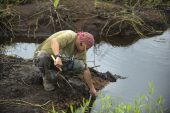
03-09-14 Piñera Agrovicces, La Unión del Amparo, Los Chiles de Alajuela
Inspección del Tribunal Ambiental Administrativo a Piñeras de la zona para verficar cumplimiento de medidas cautelares y abrir nuevos expedientes
Juan Sánchez, Biólogo especialista en manglares y humedales del Tribunal Ambiental Administrativo
Foto: LUIS NAVARRO
In July, the Municipal Council of Los Chiles in northern Costa Rica, one of the poorest regions in the country, declared a five-year moratorium on expansion of pineapple production in the Los Chiles county citing concerns over health and environmental problems affecting local residents.
This week the Costa Rican Constitutional Court, the country’s highest court, annulled the moratorium, saying, “The democratic exercise by communities and local governments to decide on an appropriate path to the wellbeing and health of their own community has limits, and one of those appears to be the freedom of private business,” read part of the court’s sentence (011545-16), according to preliminary statements by the judiciary press office.
News of the high court decision, which is still being written up for publication, alarmed local residents who perceive their health and wellbeing as endangered by current pineapple growing pracices, reported El Diario Extra.
In the sentence, which received the vote of all but one judge, the high court, reported ElMundo.cr a Costa Rican digital news site, ordered the Los Chiles municipal government to cover the legal fees of the affected party, as well as losses and damages. Judge Fernando Cruz Castro pronounced himself against the injunction.
The moratorium was challenged by the National Chamber of Pineapple Producers and Exporters (CANAPEP), who filed for an injunction against the Municipal Council of Los Chiles, reported the Costa Rican daily ElPais.cr.
In an interview with ElPais.cr, one moratorium effort leader, Jeffery López, said that moratoriums are an instrument that allow local communities to study a situation of concern and decide whether certain activities are dangerous to local residents. He said that in Costa Rica there are no existing technical procedures for determining which areas are appropriate for different types of agricultural production.
Gerardo Barba, resident of the low-lying Los Chiles area, and active member of the moratorium movement, expressed to ElPais.cr his concern over contamination of ground water by chemical run-offs, and stresses on subterranean acquifers which are being deeply and intensively tapped by the pineapple growers for their crops.
Both López and Barba expressed concern that money-making activities are being prioritized over the wellbeing of local communities, the environment, and workers’ rights.
They also stated that President Luis Guillermo Solís talked about establishing a pineapple moratorium during his presidential campaign.
The Los Chiles moratorium was drawn up with broad support from local residents, trade unions, environmental groups, civic groups, and Broad Front Party legislators, according to media sources.



