


 SIGN UP FOR OUR

How, and why, would a jaguar paint?
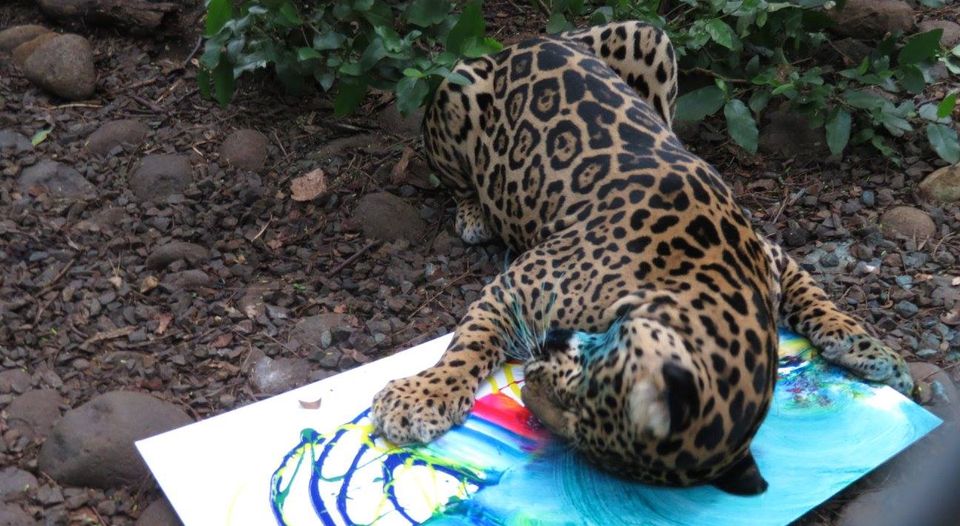
Staff at the Las Pumas wildlife rescue center in Cañas, Guanacaste, Costa Rica got inspired with the idea when trying different things to ease the stress of captivity on one of their rescued female jaguars, named Curubanda.
They spray a canvas with pheromones, which attract the jaguar to roll on it. Add some color – and boom, a unique wildlife painting is had. The unusual pieces serve as a focal point to the non-profit, non-governmental center’s annual fundraiser at which local donated art, and now the jaguar’s pieces, are auctioned off.
When Esther Pomareda, Las Pumas biologist, found that Curubanda, who came to the center in November 2012, seemed to experience reduced stress with the pheremone-laced canvas experiment, they realized they’d hit upon a solution with more than one benefit.
“Painting is an activity that de-stresses and she really seems to enjoy it. She can spend about 10 minutes with the canvas, and then I take her off, because there after that she gets so excited, she starts playing with and breaking the canvas,” detailed Pomareda in an interview with La Nación, Costa Rica’s Spanish daily.
The center’s second edition of the “Rescat-Art” auction will be held today, Thursday, August 10, and also features works by the artist collective, Plein Air Costa Rica, who were inspired by the animals that live ar this center and donated some 30 pieces to the cause.
“The idea of having her paint emerged as an alternative to reduce the stress, and later we saw the opportunity to give value to these paintings, and use them to raise funds to help the rescue center, ” said Pomareda.
Every year, Las Pumas receives some 150 animals that have either been rescued due to an injury or illness, or have been abused or illegally kept in captivity. The center is able to release about half of these, but the others can not be reintroduced into the forest because of physical limitations or behavioral alterations due to being accustomed to humans.
Curubanda, was rescued by officials from the Guanacaste Conservation Area (ACG) in 2012. The animal, who was a cub at the time, was in the yard of a house, and had been cornered by dogs.
“When she got to us, she was very skinny and weak,” Pomareda said.
Veterinary doctor of Las Pumas, Marta Cordero, over time, as the rescued jaguar recovered, noticed the cat behaved differently.
“We started to notice problems in her eyes, she never made direct contact with one and we realized that she was cross-eyed, which made it impossible to release her, as this vision problem would make it difficult to get food,” explained Pomareda.
The Las Pumas center uses techniques to reduce the stress of captivity by stimulating wildlife and exposing them to stimuli similar to what they would receive in the wild, to the extent possible.
Toys, games, food variations, and special designs of enclosures can reduce the stress of animals in captivity.
Pomareda said she tries to make the cages look like the natural habitat of the species by using logs, leaves and even trees and constantly changing their type and positions.
Food for felines is placed in changing areas to stimulate their hunting senses.
“Cougars, for some reason, do not like to paint. It’s weird – they don’t react to the scents even though different scents are used,” said the biologist. “Curubanda does react to the pheromones that are applied to the canvas, and that are mixed with the nontoxic paints,” she added. “The advantage that Curu has is that since she doesn’t see well, she is not afraid of the canvas, and she is still young and playful.”
Those interested in purchasing a Curubanda painting can write to [email protected]. You can also contact the rescue center through Facebook: www.facebook.com/CentroRescateLasPumas.



