


 SIGN UP FOR OUR
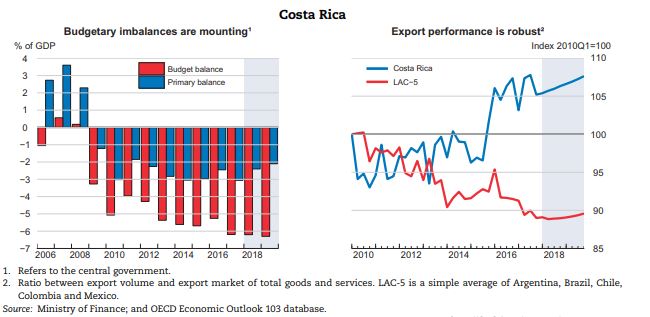
The Organization for Economic Cooperation and Development (OECD) presented its Economic Outlook report 2018-2019, and in the specific case of Costa Rica affirms once again that the major domestic risk the country has involves the high fiscal deficit and the rapidly growing public debt.
The report stresses that if left unaddressed the fiscal deficit and the growing public debt could end up threatening macroeconomic stability and the country’s successful development model; but these are not the only risks:
“In international markets, disorderly corrections in asset prices that create financial turbulence, and faster-than-expected monetary policy normalization in advanced economies, could trigger capital outflows that would lead to unanticipated currency depreciation. This would in turn weaken Costa Rica’s fiscal position even more and threaten financial stability, as the Costa Rican banking sector is still heavily dollarized and a high share of dollar-denominated loans are extended to unhedged borrowers”, warns the report, which also explains some of the difficulties the county’s economy faced during 2017.
“While output growth remains above 3%, it was lower than expected in the second half of 2017 as adverse weather conditions, including tropical storm Nate, disrupted agricultural production and ongoing construction projects. This disruption, along with rising interest rates, resulted in contracting private investment. Robust output growth has not translated into a strong labor market, with the unemployment rate remaining above 9% and more than 40% of workers holding informal jobs”.
However, not everything is negative, the report also states that: “Growth is projected to pick up due to stronger external demand supporting exports, including tourism and skill-intensive professional services, which will also help improve the current account. Investment is also projected to strengthen, owing to stronger public infrastructure spending and reconstruction related to hurricane Otto and tropical storm Nate”.



