


 SIGN UP FOR OUR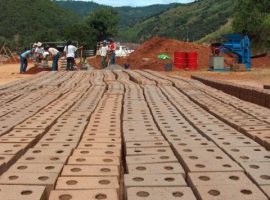
Due to the mild and welcoming weather that can be enjoyed throughout most of the country, Costa Rica is an ideal location for eco-friendly construction techniques. This is a country that has pioneered many sustainable practices over the years, particularly with regard to residential construction materials and techniques. To this end, “eco bloques” (eco-bricks) have been attracting plenty of attention lately, and they are just one of the various eco-friendly construction options in Costa Rica.
Eco-bricks are manufactured in Costa Rica by more than one company, but there seems to be controversy to this effect. The Costa Rica Star has previously described one eco-brick or eco-bloque operation that may not be doing business at this time:
[eco-bricks] are blocks of compressed soil and 10% or less cement, that are aesthetically pleasing as well as cost and energy efficient, fire and pest resistant, virtually soundproof, bullet proof, durable and structurally sound. They provide complete architectural freedom and are made from a non-toxic readily available natural raw material, dirt.
Whether these non-toxic masonry blocks can be assembled together to comply with seismic building codes in Costa Rica remains to be seen. Earlier this year, a man named Wayne E. Bird was interviewed by eco-friendly news site Pura-Verde.com and explained that:
I was actually introduced to these products by a con man from the US. Long story but he professed to have exclusive rights to Costa Rica for Compressed Earth Blocks (CEB’s). He did not.
There is an interlocking block made by a machine manufactured in South Aftrica called Hydraform. I spent 12 month trying to get approval for use of this style block. Finally I was told ‘Never going to be used in Costa Rica”. “It has no provisions for vertical rebar”. “It will never meet the seismic codes and requirements in Costa Rica.”
There is a con man operating in Costa Rica at this time trying to sell these interlocking blocks and “exclusive rights” to manufacture them in Costa Rica. Watch out for this scammer. He works his way into communities by going to church there.
There are a couple other people in Costa Rica trying to sell earth block products but I caution anyone to look into their testing documents and association [with material testing laboratories].
Although eco-bricks have become popular in the 21st century, they have been in use in Costa Rica for over five decades. They are getting plenty of attention now because their use is contributing towards Costa Rica’s goal of becoming a carbon-neutral country in the next seven years. The Costa Rica Star has previously reported on other cost-efficient and sustainable residential construction projects:
Ferrocement
Ferrocement, as the name implies, is only cement and steel, mixed and applied in a special way. It basically consists of screen mesh or layers of chicken wire covered with special recipe cement that is mixed not according to volume but according to the weight of its ingredients.
It is especially ideal for the tropics, because it is very cheap, strong, lightweight, cool, waterproof, and so varied in its applications that it can be used for making almost anything you can imagine.
Benjamin Garcia Saxe: Ultra-Green Architect
The work of Mr. Garcia has been featured a couple of times in the pages of the Costa Rica Star. He is the architect who can make homes levitate in Playa Santa Teresa. He is also responsible for two residences that are extremely earth-conscious: The Forest for a Moon Dazzler bamboo residence in the forest, and the Containers of Hope residence located 20 minutes outside of San Jose.
There is a very touching story behind Forest for a Moon Dazzler that everyone must read, but it is also important to note the incredibly low carbon footprint of this house and the fact that it cost just $20,000 to build. Containers of Hope cost twice as much, but the smart recycling of intermodal containers (conex boxes) makes this construction very sustainable.



