


 SIGN UP FOR OUR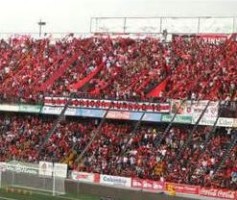
A well-behaved La Doce displays fan devotion
Since the early afternoon of Thursday, October 23rd, the national police force of Costa Rica kept watch outside the Ricardo Saprissa Stadium in the suburbs of San Jose. Mounted police and special units of Fuerza Publica assembled hours before the match between the Deportivo Saprissa and the Sporting Kansas City, the latter of the United States Major League Soccer. This police operation was designed to prevent the violent events during a Sunday match eight months ago between First Division teams Liga Deportiva Alajuelense (LDA, the current champion) and Club Sport Cartagines (CSC).
Security officials are calling attention to a rising trend of football hooliganism in Costa Rica and the likelihood that violence and criminality could escalate to levels seen in Argentina, Britain and Russia.
At the “Fello” Meza stadium in the former capital city of Costa Rica back in February, members of “La Doce,” the LDA organized fan club, showed up in significant numbers despite this being an away game. The match was crucial for both teams as LDA wants to consolidate its First Division leadership and clinch one more championship to increase their number of national titles and surpass the record currently shared with arch-rival Deportivo Saprissa. For CSC, the match was also crucial to keep their hopes alive and give fans their first championship in more than 70 years.
What happened at the stadium in Cartago was something that police officers and investigators in Argentina, Britain and Russia are used to guarding against: Violent outbursts, vandalism and vehement behavior; a textbook example of football hooliganism. It was in the seats that members of La Doce (The Twelfth, an allusion to fans being the 12th member of a football team) brought on mayhem and threatened to take over the entire stadium as they physically assaulted CSC fans and chased women and children out of the stadium so that they could ply their violent trade. They did not care about the presence of Fuerza Publica, Costa Rica’s national police force, at the stadium; in fact, they seemed ready to battle against the riot control officers.
In the end, the match had to be suspended; a first-time occurrence in the long history of First Division football in Costa Rica. The violence was broadcast live on television; football fans were shocked and members of Fuerza Publica and the Organization of Judicial Investigations (Spanish initials: OIJ) prepared to clamp down on barras. In the meantime, team managers and owners have been quick to distance themselves from barras, but investigators should not be surprised to find some level of association.
Hooliganism is at its most dangerous when it reaches subcultural status. Irvine Welsh’s first novel, Marabou Stork Nightmares, spun a tale of a “fitba casual,” a hooligan who finds affinity in the organized violence related to football matches in Scotland. Some of the details of the hooligan lifestyle in that novel are being discovered in police investigations in Costa Rica: Disenfranchised young men, the use of advanced text messaging through mobile apps, concealed weapons, using matches and violence to coordinate other crimes, complex transportation schemes to travel to away games, drug use, etc.
Football matches have traditionally been considered family-friendly events in Costa Rica, but that has not been the case since the turn of the century. Organized fan clubs, known as barras, started in the late 20th century with La Ultra Morada, (Ultra Purple) club in support of the legendary Saprissa, which is the most popular team in Costa Rica and one of the most respected in the CONCACAF. OIJ agents have interviewed Ultra leaders and conducted three arrests on Thursday after reports of a violent altercation that also involved firearms. This arrest happened just two days after members of La Doce were taking into custody, and law enforcement officers are promising even more arrests.
One of the problems that investigators are seeing with these barras is that they provide strength in numbers for members of street gangs such as MS-13, known as La Mara Salvatrucha, a dangerous street gang from California that has caused problems across Central America and around the world. MS-13 members have attempted to take over the lucrative retail narcotics trade in Guanacaste, which often caters to tourists and expats. With the prospect of football interest growing even stronger in Cost Rica over the next few months, residents are worried that fearsome barras will accompany their teams on away games and impose their hooliganism in various communities across Costa Rica.
At the time this story was filed, Saprissa was ahead by two goals over Kansas City, thus continuing to the next round of the CONCACAF Champions League, in which three First Division teams from Costa Rica have secured berths.



