


 SIGN UP FOR OUR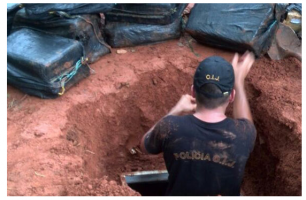
(OIJ Photo)
A former official of the Costa Rican Pacific Ports Institute (INCOP) along with three other men were taken into custody after a police raid on a farm in Mogos de Sierpe in Osa, Puntarenas Tuesday afternoon that led to the discovery of some two tons of cocaine, according to the Ministry of Public Security (MSP).
Agents from the Judicial Investigative Police (OIJ) raided the property after receiving reports of unusual activity at the location, authorities said.
Drug canines subsequently led authorities to what seemed to be nothing more than a patch of dirt, until officers began digging and discovered the opening to a sort of underground cellar containing the massive haul of some 2,000 kilos of cocaine.
OIJ officials said that the cocaine is believed to have recently arrived in the country by sea, without providing additional details.
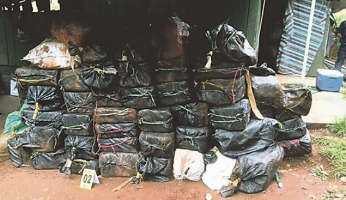
(OIJ Photo)
Four men were taken into custody during the raid, including a 30-year-old man identified by the last name Flores. Flores worked for INCOP until early 2015, though his role at the public agency wasn’t immediately clear. The three other men were identified by the surnames Bermudez, Aguero and Serrano, all Costa Rican nationals.
Meanwhile, agents were continuing to search for a fifth man Wednesday morning who managed to escape capture during Tuesday’s raid by fleeing into the mountains.
Costa Rica authorities expect record year for cocaine trafficking
Costa Rica’s Ministry of Public Security (MSP) and Drug Control Police (PCD) are expecting a record level of cocaine trafficking through the country this year, due in large part to increases in production in the source countries of Colombia, Peru, and Bolivia.
The MSP estimates that some 1,700 tons of cocaine will flow through Costa Rica this year, a nearly 42 percent increase from the 1,200 tons estimated to have been trafficked through Costa Rican territory in 2015 and 2.5 times as much as the 670 tons believed to have been trafficked through the country in 2014.
According to the PCD, the amount of land dedicated to coca production – the plant from which cocaine is derived – in producer countries has increased, as well as the quantity and quality of the harvest.
Authorities in Colombia announced earlier this month the largest single seizure of cocaine in the country’s history, after seizing eight tons of the drug from the country’s most active criminal syndicate, the Usuga clan.



